
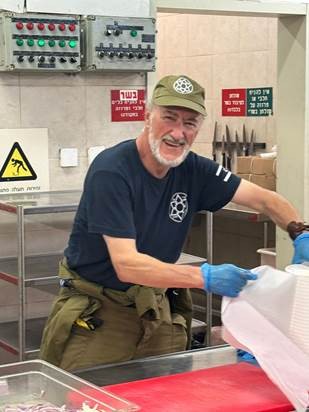
A Sar-El mission that provided meals for nearly 24,000 IDF soldiers
By Gene Jura / Special to the BJV
Like most Jews after the atrocities of October 7, 2023, I was depressed and angry at the one-sided news coverage by Western mainstream media, and looked for a way to channel my energy in a positive way. An internet search led me to Sar-El, an organization affiliated with the Israel Defense Forces that offers volunteer opportunities in Israel on IDF military bases.
In mid-October 2025, I flew to Tel Aviv. A few days later I met a few hundred volunteers (most between 50 and 70 years old) from all over the world at Ben Gurion Airport, where Sar-El organizes volunteers from 35 countries into groups and then sends them to various army bases across Israel to do their volunteer work. Even when approaching the Sar-El assembly point at the airport, there was a buzz of palpable excitement in the air. As it turns out, some of the volunteers are “repeat offenders” who, in some cases, have been returning for 40-plus years. Old friends and acquaintances were engaged in lively conversations, and even though this was my first time, I soon found myself drawn into friendly conversations with total strangers. After about an hour, the registration process was complete, and my group of approximately 30 volunteers from 12 different countries (half of them women), was transported via air-conditioned bus to a large logistics base in the vicinity of Be’er Sheva.
On the bus, I made fast friends with a gentleman from Newport, RI, who looks like a tanned Swiss mountain guide and is not Jewish, but who felt a strong need to contribute to Israel after feeling that “Israel is being bullied by everyone, especially Western media.” As it turned out, about half the volunteers are not Jewish and what you might call “Chovevei Tzion” (Lovers of Zion). They come out of conviction that Israel, and Jews in general, are being unfairly targeted by the rest of the world. Hence, they come to Israel to remedy that situation by personal example, sometimes to make the point that they vehemently disagree with their country’s government and politics – as was the case with a contingent of 6 Spaniards in my group.
The drive south through the Negev desert revealed large swaths of green that have been wrested from the desert through irrigation. After a 90-minute drive, we arrived at the base, where we were separated by gender and sent to living quarters where four of us shared a communal room similar to “summer camp for adults”. The rooms have bunk beds and are identical to the ones used by IDF soldiers, but with deference to our age, only the lower bunks were used. In view of outside temperatures in the 80s, we noticed with delight the one luxury: air conditioning !!!
We were greeted by our madrichot, the young female IDF instructors responsible for us and for coordinating our work with the IDF soldiers in charge. They shepherded us to the dining hall, where we were treated to an unexpectedly good lunch with various choices of salads, vegetables, meats, fish and fruit. After lunch, we were given a brief introductory talk in English (the lingua franca in view of the many different countries volunteers come from) about our responsibilities. We were asked to refrain from discussing politics and religion while on the base, similar to what is expected of IDF soldiers.
The daily routine consisted of breakfast from 7 a.m. to 8 a.m., a brief flag raising ceremony at 8:15 followed by work between 8:30 and noon, lunch until 1 p.m., and then a return to work until 4 p.m. After dinner wrapped up at 7 p.m., the madrichot led a one-hour presentation on a specific topic, a group discussion, or a workshop relating to Israel or army life. We also received green military uniforms consisting of a cap, jacket, trousers and a belt, as well as special blue Sar-El T-shirts that we wore while on base and working, though we were free to wear casual clothing in the evening.
Our first assignment was working on a warehouse assembly line packaging food into cardboard boxes to be shipped to combat soldiers. Such boxes contain food for four soldiers, their contents rather nutritious and healthy: canned tuna, vegetables, crackers, nuts, condiments, coffee, and tea. During 3.5 days of work, we managed to pack nearly 6,000 boxes, i.e. meals for almost 24,000 soldiers, a tangible result for volunteers with no prior experience in “food engineering.”
To keep us motivated, music – mostly Israeli – played constantly. Groups of local high school students joined us for 2 hours each day on the assembly line. We had interesting conversations with them as well as with the supervising soldiers. Although we were supposed to avoid politics, inevitably we ended up discussing the “current situation” (ha’matsav). Everyone was polite and respectful and, despite occasional disagreements, we felt very much appreciated as volunteers and frequently shared heartfelt moments and laughter with both students and soldiers. Considering the age of our madrichot (18 and 19 years old) and other soldiers we met – among them 2 tank commanders who were barely 20 years old and in charge of 3 other soldiers entrusted to them, as well as a 70-ton tank – I was humbled thinking about the awesome responsibility placed on their shoulders and the maturity they demonstrate. I found myself wondering about the many young people in Western countries who are “still searching for themselves” in their late 20s.
In the evening, we had our first “activity”: getting our blue shoulder stripes identifying us as Sar-El volunteers to others. In the coming days, it became obvious that most soldiers have never heard of Sar-El even though it’s an integral part of the IDF’s Logistics unit and has been around for more than 40 years. In conversations with young soldiers in the dining hall, we were frequently met with looks of surprise and astonishment: “You’re what? A volunteer?! Can’t believe you’d volunteer to be here on an army base! At your age? Wow!” A very touching moment was when a silver-haired soldier approached and asked us in Hebrew to which unit in the Milu’im (army reserves) we belonged. It turns out he’s 81 years old and volunteers as a tank driver to ferry tanks from Gaza to this base for repairs. He was flabbergasted that we came from abroad to volunteer at an army base and thanked us for our service. Young soldiers gathered around us and cheered us on.
The best part – aside from feeling useful in providing a small but important service for the IDF’s humanitarian needs – was the camaraderie that developed among the volunteers. In spite of various national and language backgrounds, we quickly developed strong group cohesion and a common sense of purpose. Deep conversations happened daily and invitations flew across four continents! After four-and-a-half days of this routine, we were sent back to Tel Aviv by the base commander with great appreciation for our service. He emphasized that our physical achievement, packing 24,000 meals, was but part of the accomplishment. The more important and invaluable part was the love and support we provided for the young soldiers who feel beleaguered and unloved by the rest of the world. We said an emotional goodbye to the many soldiers we got to know in one-on-one conversations. It felt very much like saying goodbye to family, and some volunteers were in tears. Many – myself included – have already committed to coming back with Sar-El next year.
The deep bonds formed with some of the other volunteers surprised me, as I arrived in Israel with no such expectations. The sense of unity and common purpose lifted up all our spirits and gave a new meaning to “Am Yisrael Chai!”
Dr. Gene Jura is originally from Israel and was educated in Europe. He came to the United States 42 years ago and worked as a pediatrician for 40 years. A Berkshires resident since 2011, he is a member of Knesset Israel in Pittsfield.