
By Albert Stern / BJV Editor
Last November’s Jewish Federations of North America General Assembly was the first such confab of our umbrella organization I attended in nine years. The Jewish world has changed utterly since my participation from 2014 to 2016, and I couldn’t help reflecting on the differences in focus and tone from both Federations’ leadership and my fellow participants – changes I perceive as largely for the good in guiding Jewish Federations’ urgent work in protecting and strengthening Jewish life in this country and abroad and in helping to rebuild Israel.
Milestones that reshaped the Jewish communal conversation since 2016 include two very different administrations in the White House, the Covid-19 pandemic, the Abraham Accords, Oct. 7 2023, the Gaza war against Hamas, the defanging of Iran and Hezbollah, and the worldwide spike in gutter, casual, and institutional antisemitism.
And how has the Federation system responded to these world-changing events? As encapsulated by CEO Eric Fingerhut at the closing plenary, “We have been through a war together over these past two years. A war with soldiers and guns in Israel and a war for hearts and minds here in North America…It is important for us to understand that what happened to us over the past two years is not a minor blip. Like the Hamas attack on Israel, we have experienced a planned and coordinated attack on Israel’s standing in North America and on the Jewish community that supports Israel. It was fueled by billions of dollars of dark money from around the world…and was spread by the most powerful algorithms and communication tools ever invented. We went into this war in our communities with the army we had…but it was a formidable army.”
After outlining the stakes, Fingerhut listed some of the sometimes-overlooked realities of the Jewish community’s strengths. We live in the strongest and freest Jewish Diaspora in the 4,000-year history of the Jewish people. We are largely self-sufficient and not dependent on a single politician or political party for our safety, welfare, or livelihoods. The Federation system and its partners have an unmatched ability to direct funds where they are most needed in the Jewish world – and Jews are supporting Federation more generously than ever (see the related story on page 1). At home, Federation has built a security network with a presence in every Jewish community. Israel is a successful, innovative, and militarily powerful nation-state in the process of strengthening its position in the Middle East. Overall, the American Jewish community has been able to achieve its political objectives. And most importantly, we are poised to rebuild from a position of strength.
The consciousness expressed by Fingerhut pervaded the General Assembly – its theme, “Rebuild Israel.” In years past, buzzwords and phrases might have been ‘peoplehood,’ ‘meeting someone where they are,’ ‘Jewish journey,’ and even ‘tikkun olam.’ This year, the word I heard repeated most was ‘algorithm’ – always with urgency, in full recognition of how social media platforms have amplified Jew hate and the even greater menace these algorithms might pose to Jews in the future. Many of the breakout sessions centered around explaining how these poisonous algorithmic calculations operate, the effects they’ve had on public perceptions and discourse, and how people working in the Jewish world might combat their pernicious effects.
Throughout the GA, I was reminded of Samuel Johnson’s observation that “when a man knows he is to be hanged in a fortnight, it concentrates his mind wonderfully.” There seemed to be an awareness, expressed by former White House speechwriter and author Sarah Hurwitz, that “it’s becoming increasingly clear that the kind of content-less ‘bagel and lox Jewish mother joke’ identity that many American Jews have just doesn’t cut it anymore. When your Jewish identity is a big empty void with a few ethnic jokes rattling around in it, it will be filled by what is around you. And if what is around you is antisemitism, you will be helpless to fight back.” And what was especially heartening was that sentiments of that sort were expressed most clearly and forcefully by younger speakers and participants, the cohort whose engagement in Jewish life and grasp of Jewish identity were fretted over at my last GA experiences a decade ago.
Throughout the GA, the blows the Jewish people have taken over the past two years were recognized and appropriately grieved over; but you could sense that they were also starting to be fixed into the broader scope of Jewish history, a process in its earliest amorphous stages. Again, we are moving from strength to strength – in November, “Jewish Federations of North America reported a record-breaking year of fundraising and investment in Jewish communities in 2024, as surging engagement in the aftermath of the October 7 attacks brought the total amount the system raises and distributes up to $3 billion, about $1 billion more than in a typical year, including $683 million in Israeli Emergency Campaign funds.”
The 2025 General Assembly did much to define what those strengths are and how they might be leveraged. Here are some impressions of the 2025 General Assembly.
Day 1
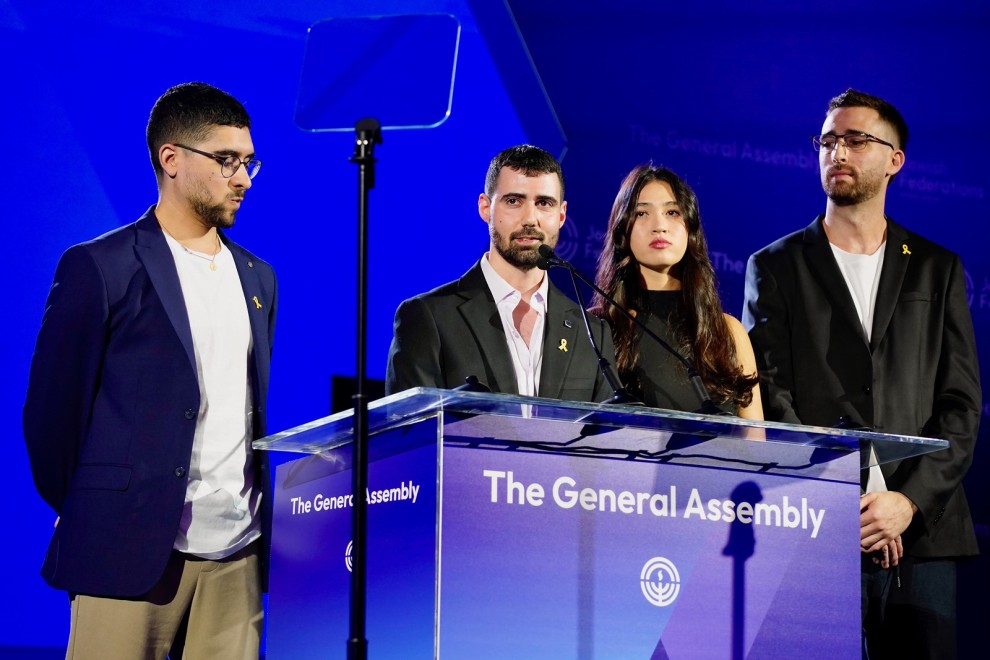
“But today we breathe a sigh of relief…” The GA’s opening moments were also the most emotional. Following a montage of hostages released from Gaza reuniting with loved ones, appearing onstage were Noa Argamani and the recently-released Evyatar David, Guy Gilboa-Dalal, and Avinatan Or. Noa recounted her experience in captivity, how she asked every day about her friend Avinatan. “For months I did not know if he was still kidnapped, or murdered,” she remembered. “In captivity, I asked about him again and again and again. But there was no answer…and I was afraid to know the answer.” She described the horror of seeing two of her fellow captives brutally murdered, and at her gratitude at being rescued by IDF soldiers, one of whom, her “hero” Arnon Zmora, was killed during the operation. Avinatan, who spent 738 days alone imprisoned in Hamas tunnels and had known freedom for scarcely one month. He described the strategies he used to survive in captivity, and the mantra he arrived at to keep himself human: “This too shall pass. Patience. Let it be.” He said he didn’t consider himself a hero – those were the soldiers of the IDF who put their lives on the line to rescue the hostages – and shared that “his next mission” will be to work with those warriors. “Because I did survive,” he said, “I carry a responsibility. To talk about patience, about humanity, and about complexity. The responsibility to know good from evil, right from wrong, and to have moral clarity.” We have, he concluded, “a responsibility for unity.”
And one realized that the sight of Noa and Avinatan embracing, and hearing the words of Evyatar and Guy, were things we couldn’t have imagined even a few weeks earlier. Their world changed so much in that short amount of time, and to see them with the fortitude to so soon share their stories was inspiring.
Gary Torgow, chair of Jewish Federations’ board of trustees, emphatically voiced the importance of returning to the fundamentals of Jewish peoplehood, a message that had started to crystalize among Federation leadership at my last GA nine years ago. His words were forceful and direct, with an unmistakable undertone of religious conviction – “So where does our salvation come from? What has sustained the Jewish people through centuries of exile and persecution?” Torgow asked. “The answer never lies in politics or politicians, or power or the strength of a society, but in timeless messages transmitted from heaven. Judaism teaches us a foundational lesson in the words spoken to us collectively at the Sinai mountain when we were gifted with the Ten Commandments” and became “a free people together.” It was the kind of rhetoric that, in my previous experiences at the GA, would have been the purview of a clerical speaker like Rabbi Jonathan Sacks z”l, not a lay leader. To my ears, Gary Torgow, as a Federation leader delivering high-profile speeches at the opening plenary and then later at the closing plenary, was asserting that religious identity and secular identity could no longer be bifurcated for Jewish people. Our enemies don’t make distinctions and our survival may depend on us not doing so either. It was a message that suggested that the “do Jewish the way you do Jewish” approach will no longer work as a way forward, and that resonated for someone like me whose Jewish identity is rooted in faith and tradition, however imperfectly. Maybe it will for you, as well – I encourage you to watch Torgow’s speeches, which you can access online at generalassembly.org.
*
At the last panel discussion of the opening plenary, Sarah Hurwitz ignited what was later described as a social media firestorm with her thoughts about the way that using Holocaust education as a form of antisemitism education was no longer working in an increasingly “post-literate” TikTok world. Her main idea was that the Holocaust is taught as a narrative of powerful oppressors victimizing the weak, and that young people bombarded with images (real and contrived) of a powerful Israeli army fighting against a seemingly weak population in Gaza find it confusing to discern who is might be in the right during the current conflict. Her belief is that Jewish education for Jewish youth has to be improved because in the social media age, bad ideas and bad actors using algorithms are finding young people through their smart phones. Where at one time Americans got their news through mostly American sources with cultural and journalistic guardrails in place, social media is international, where narratives are amplified from around the globe, from places that do not necessarily care much for Jews.
Hurwitz’s message about solutions was nuanced – again, visit generalassembly.org for more – but her diagnosis of the problem was among the best analyses by any of the speakers I heard at the GA.
Day 2
The second day opened with what to me the most heartbreaking segment of the GA. It centered around a performance by the house musicians for this GA, The Tamari Project, a musical initiative in memory of Tamar Kedem Siman Tov, who was murdered on October 7 with her entire family: her husband Jonathan, twin six-year-old daughters, Shachar and Arbel, and two-year-old son, Omer. During the Gaza conflict of 2014, Tamar was part of the team that established the music and art school Bikurim, and later became the principal of Israel’s first youth village for young musicians. Located on the Gaza border. It was a magnet for talented musicians from across the country. Members of The Tamari Project are the graduates and colleagues of Tamar from Bikurim.
Video from Tamar and Jonathan’s wedding at Kibbutz Nachalat Oz played as The Tamari Project performed, honoring the memories of their friend and mentor and her family. Seeing images of the couple on their happiest day while knowing what fate had in store for them and their yet-to-be-conceived children just a few years later was a wrenching experience, and brought home another dimension to all that was lost on Oct. 7, 2023. The Tamari Project musicians embodied the GA’s theme – “Rebuilding Israel” – and demonstrated how Israelis are channeling their trauma.
+
The morning plenary continued with a roundtable featuring Olivia Reingold, a young journalist doing great work for The Free Press showing how misleading images from Gaza drove an anti-Israel narrative. Her reporting last summer forced many news outlets to issue corrections, but also stimulated a barrage of hateful messages, and even death threats, on her social media. Her response? She started wearing a Star of David necklace for the first time in her life, with the attitude that “if you have a problem with Jews, then say it to my face. When I wear it in public on the New York subways, I want people to know they are in the presence of Jews and we’re just like them, member of their community.” She shared that her reporting leads her to believe that the Democratic Socialists of America represent a great challenge to the Jewish community. Nationwide in scope and growing, “they are highly, highly organized where gaming out city council races and school board races in suburbs and towns across America. This matters for Jews because, I think it’s fair to say, that they have an eliminationist policy when it comes to Israel. At their convention over the summer they passed resolutions that said to be a member of the DSA and to earn their political endorsement, you need to be okay with Palestinian violence.” The challenge, in Reingold’s opinion, is for the Jewish community to come up with a way to be as politically motivated as this highly-motivated opponent – but that she doesn’t see that coalescing as yet. “I feel like we have converted everyone who is open to our cause,” she said. “We have a huge problem reaching new audiences of people who are approachable and persuadable.”
On the same panel, the Pastor Juan Rivera of the evangelical New Life Church in Youngstown, OH, shared the ways his Hispanic congregation support Israel and the Jewish community. He shared the challenge he faces preaching from the pulpit against the confusing antisemitic messages that are amplified online. In his church, he said, “we built the house for the storm,” and so his congregants wear the Star of David as an expression of allyship. “It’s an opportunity to build courage and clarity around these issues,” he asserted. For Pastor Rivera, after Oct. 7 2023, it was not enough to say ‘we stand with you,’ but rather we stand as you.”
Third panelist, publisher Zibby Owens, detailed the ways members of the publishing industry has worked to cancel pro-Israel – book contracts were canceled, literary agents dropped authors, writers were disinvited to conferences, and blacklists were circulated. Owens herself became a lightning rod for controversy when she withdrew her company’s sponsorship of a literary festival whose organizers planned to give attendees free rein in expressing anti-Israel and even antisemitic sentiments from the podium. The last two years have been marked by cancellations and betrayals, she said, that are still ongoing. Her wish is for the Jewish community better organize itself and its messaging. “Look, people are scared to speak out,” she said. “As Jews, we’ve survived in the past by hiding. The instinct to speak out is not necessarily there. But if we don’t speak out now, then what?” She concluded by asserting that organizations like Federations have a great opportunity to encourage their community members to speak up.
Reingold, Rivera, and Owens all offered tangible ways to move forward – none were particularly optimistic about things dying down, it has to be said. Their overall message – we have to figure out how to fight back better.
+
The breakout session I found most valuable as “Countering Hate, Online and in the Press,” in which panelists really broke down the realities of what goes on online. Imran Ahmed of the Center for Countering Digital Hate, explained the pernicious quality of the algorithms amplifying hate – for one, the hate does not come from organizations per say, but rather burble up from the internet interests of users around the world. Even if one engages with hateful messaging to object to it, that engagement further amplifies the hateful algorithm. The war we’re fighting, he asserted, is not a culture war, but an information war. “We’re not fighting an idea, we’re fighting algorithms.” Moreover, for social media outlets, amplifying antisemitism is “a business choice. They profit from engagement and hate drives engagement. Outrage and clicks outweigh the truth.” We have to change the battlefield, asserted Ahmed, but the problems we are facing are new and we don’t have solution as of yet.
Interestingly, a week or so after the GA, Elon Musk (as reported by the New York Post) “recently unveiled a feature that publicly displays key background information about an account, including the location on where it’s based. The feature has already unmasked a sprawling ecosystem of accounts taking advantage of disasters and political unrest across the world, including inside the war-torn Gaza Strip.” The new feature exposed how algorithms are being driven by dummy accounts from around the world – many in the Middle East and Pakistan – that exists to boost divisive messages about Israel and American politics. For me, that new information offered a glimmer of hope to counter Imran Ahmed’s dire message.
Day 3
The last GA I attended fell days after the 2016 election of Donald Trump as president – not the outcome that was anticipated or preferred by the majority of participants at the conference, it is fair to say. And so GOP Senator Ted Cruz’s warm reception at this GA seemed to be something of a bellwether of how political perceptions have changed since 2023. Cruz – like his Senate colleague John Fetterman, who appeared on day 2 of the GA – shared his full-throated support of Israel. And while the Texas Republican called out the antisemitism on the left, he was equally harsh toward the antisemitism that is increasingly out in the open on the far right, which he asserted is real and organic and not particularly driven by algorithms and online astroturfing.
While I could see that some in the audience did not applaud the senator or rise at the end of his speech, the overall reception Cruz received made me consider that people working in the Jewish world have realized that our allies are going to be found in the political center rather than the fringes, and that maybe we can heal political divisions within our own community by using attitudes expressed toward Israel and antisemitism not necessarily to inform our political values, but how we express them and how we might work together with people who don’t share our views.
+
As the GA drew to a close, commentator Dan Senor left us on an optimistic note that provided a big picture view of the inflection point that Israel and North American Jewry are at two-plus years after Oct. 7 2023. “The outcome of these past two years has been transformational for Israel, in the region, in the world, in a positive way.” He expressed how amazing it was that Israel could now move forward knowing this “ring of fire,” 7-front existential war it had been fighting throughout its existence was now, in large part, resolved with its enemies defeated. There is no comparison in history in which a country so completely turned around it fortune in such a short time, a tribute to the IDF and Israeli intelligence.
Moreover, Israel is due for a period of growth as the country moves off wartime footing and starts to leverage the opportunities and investments accrued during the last two years as they rebuild. Even during wartime, the Israeli innovation economy never flagged. Israeli startups are at the forefront of developing military technologies based on lessons learned from the recent conflict and are innovating at breakneck speed.
Senor, however, acknowledged that Israeli society has been shattered by the experience, and has undergone a loss of confidence in its political leadership and even in the IDF. However, he asserted that no democracy in the world could have managed the internal and external stresses faced better than Israel. “If I had to bet on a country, it would be Israel,” he said.
A positive to come out of the negative, he asserted, was that Israelis’ ideas of Jewish peoplehood had changed – before this period, they may not have thought much about the challenges of the Diaspora, but that now “they are concerned for us and worry about us” in the way we worry about them. American Jews and Israel have never been so united as they are now – Israeli Jews have recognized the support they’ve received from the Diaspora and are grateful. American Jewry is also poised to grow stronger. Our young people, Senor asserted, have to be given opportunities to live in a Jewish bubble, if only part-time, and that should be the focus of America’s Jewish community.
Federation plays an integral role in all the positive developments that Senor outlined on the stage of the General Assembly. Attending this year’s conference was a fantastic opportunity to connect with Federation’s work and the people doing it. After two long and hard years, it was energizing and inspiring to see the Jewish world moving from strength to strength, and I am grateful to be working in the Federation system.