
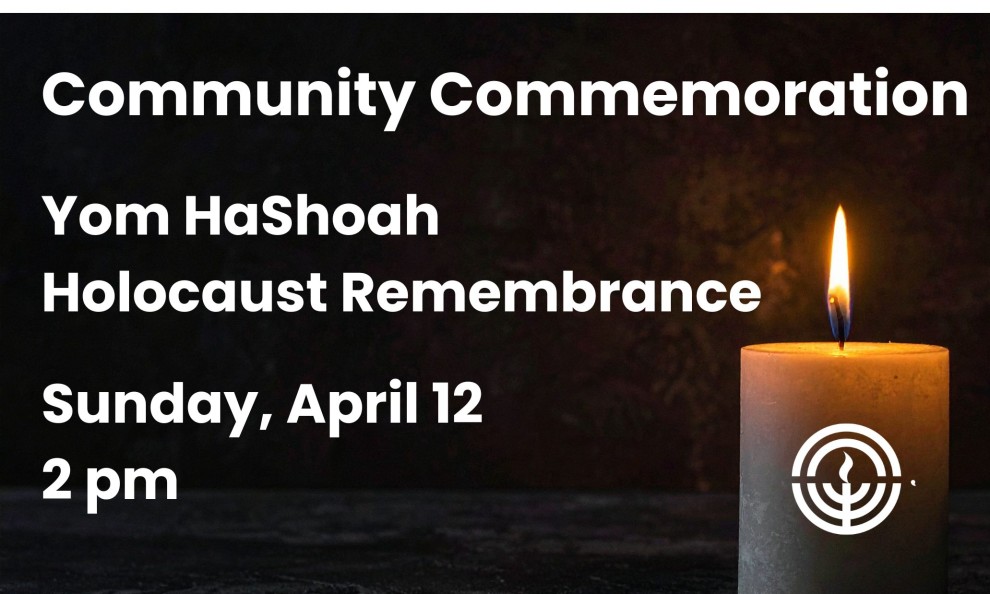
LENOX – On Sunday, April 12 at 2 p.m., join us for a moving community commemoration of Yom HaShoah – Holocaust Remembrance Day, focusing on the concept of the “grey zone” developed by Holocaust survivor and writer Primo Levi. Levi explored the morally complex relationships between Nazis and prisoners in Auschwitz, noting that life in the camps could not be reduced simply to victims and persecutors. In the grey zone, oppressors often compelled prisoners to become unwilling accomplices.
Drawing from his book Our Will to Live, Terezin Music Foundation Director Mark Ludwig will share stories of how music by Jewish composers — and other artistic expression in the Terezín concentration camp — was co-opted for Nazi propaganda. Through staged performances, a propaganda film, and a Red Cross inspection, creativity and culture were transformed into instruments of deception, illustrating the chilling moral complexities of the grey zone.
The program features Mark Ludwig and members of the Terezín Music Foundation Ensemble: Greg Vitale (violin), Jesse Holstein (viola), and Jing Li (cello). It will conclude with a memorial candle lighting, prayers, and a moment of silence in memory of those murdered in the Holocaust.
Register on the calendar of events page at jewishberkshires.org. If you are unable to attend, please notify us so your seat can be made available to other community members.
This program is co-sponsored by Jewish Federation of the Berkshires and the Tanglewood Learning Institute.
Music as a Form of Spiritual Resistance: Terezin’s Composers and ‘The Grey Zone’
By Ruth Lenore Kaplan / Special to the BJV
Yom Hashoah in the Berkshires this spring will be marked by a very special musical performance. Music educator and violist emeritus of the Boston Symphony Orchestra, Mark Ludwig, will present a string trio set to perform three musical pieces composed by Jewish prisoners of the Terezin concentration camp located in the Czech Republic. The program is entitled: “The Grey Zone: Music from Terezin and Holocaust Remembrance.”
By way of background, Terezin served as the showcase “Jewish settlement” for propaganda purposes during World War II to deceive the world of Nazi atrocities. In 1944, the Nazis invited representatives of the International Red Cross into the camp to showcase the supposedly comfortable condition of the Jews and to refute word of “the Final Solution.” Included in this ruse was a concert of classical music composed and performed by Jewish musicians interned at Terezin. In reality, 33,000 Jews died in the camp. Moreover, Terezin served as a transit stop to extermination camps including Auschwitz for 88,000 to 90,000 prisoners.
So how was this surprising story of Jewish musicians composing and performing music in the midst of extreme hardship and deprivation discovered? In 1988, Ludwig happened to read a biography of Holocaust survivor and scholar Leo Baeck. In his writings, Baeck, who survived Terezin, highlighted the remarkable musical life maintained by the prisoners, which he considered a form of spiritual resistance, despite the extreme hardships of their existence. Ludwig was inspired by this discovery and set out on a journey to Prague to uncover and preserve this rare collection of unknown music, which he hoped would also provide new performance opportunities for his string trio. As a Fulbright scholar, Ludwig searched through the Terezin archives and spoke with survivors to uncover a treasure trove of musical compositions. In 1991, Ludwig founded the Terezin Music Foundation to preserve and perform works by artists imprisoned in the camp. He continues to serve as its executive director.
What motivated these musicians to compose and perform at Terezin? And how did they manage to smuggle their instruments into the camp? It’s noteworthy that Terezin was a collection point for Jews from Germany, Czechoslovakia, and Austria, so its prisoners came from major cultural centers. Despite the fact that inmates were restricted in the number of belongings they could bring with them and musical instruments were outlawed, many musicians smuggled in instruments, often cutting them up into pieces, hiding them in their possessions and reassembling them upon arrival to the camp. It was indeed an act of courage and resistance just to hold onto their precious instruments. We can only speculate as to what these composers and musicians were thinking about their future when they engaged in musical pursuits in Terezin. We can only assume they were living in the moment. It is also hard to imagine what was going through the minds of the prisoners who made up their audiences. Most of the composers were murdered by the Nazis, fortuitously leaving behind their musical manuscripts to be discovered in Terezin after liberation in 1945. The music was for the most part not performed post-war as the Communist regime in Czechoslovakia vilified Jewish composers.
The title of this concert is “The Grey Zone,” a concept introduced by well-known Italian Holocaust survivor and writer Primo Levi. Levi coined this term in an essay he wrote in his final book The Drowned and the Saved. Reflecting on relationships between Nazis and his fellow prisoners in Auschwitz, Levi observed that “the network of human relationships inside the lagers (concentration camps) was not simple; it could not be reduced to the two blocs of victims and persecutors.” In Levi’s “grey zone,” oppressors compel their victims to become unwilling accomplices. You could say that the musicians of Terezin possessed a specialized skill that afforded them somewhat of a privileged status that allowed them to survive longer. They arguably occupied the “grey zone” of unwilling accomplices in propaganda films intended to deceive the world. But, in the end, their musical talent could not save them.
One of the very special features of the Terezin Foundation is its commitment not just to preservation but to ongoing education about the Holocaust using this precious music as a vehicle. Ludwig created a curriculum called “Finding a Voice: Musicians in Terezin.” The Foundation reaches out to roughly 900,000 students a year providing Holocaust education both in middle and high schools. In addition, they train teachers to use the curriculum. Besides the more obvious targets of the United States and Europe, this curriculum has been shared in far-reaching locations such as Mongolia and Namibia. According to Ludwig, “music and social activism go hand in hand.”
The Yom HaShoah program on April 12 will be far more than a concert: Ludwig will provide meaningful historical context to each of the musical numbers as well as commentary on the music itself. Contrary to expectations, the music is not solely sad or depressing. Ludwig calls it “a pallet of emotional content.” The concert promises to be a bittersweet experience. Two of the composers were murdered in gas chambers in their 40s and one died in his 20s. What other musical compositions could these phenomenal talents have composed if their lives had not been cut short under such barbaric circumstances? What other young musicians could they have influenced?
At the end of the day, Yom HaShoah is not just a day to remember 6 million Jewish victims of the worst human atrocity ever committed. It is a day to honor the resistance of our people who perservered and chose life in spite of the darkness. Indeed, the full Hebrew name of the day is “Yom Hashoah Ve-Gevurah,” the Day of Remembrance of the Holocaust and the Heroism. Let the stunning sounds of Terezin’s musical compositions bear witness both to the enduring power of music and to the legacy of courage and resistance this day is intended to honor.
Ruth Lenore Kaplan is a writer and consultant with a varied career including academic pursuits in Jewish history, social services and governmental work, private practice as an attorney, and public service as an elected and appointed official dealing with public education. For the past 15 years, she has served the Jewish and Israeli communities in a variety of leadership roles, including director of the Combined Jewish Philanthropies Boston-Haifa Connection and Director of Community Relations for the Consulate General of Israel to New England.