
First of series presented by Professor Joanna Homrighausen
On Thursday, December 18 at 7 p.m., join Professor Joanna Homrighausen for the first of three standalone talks on the calligraphy and mysticism of the Hebrew alphabet. This program will be presented via Zoom – register at the calendar of events page at jewishberkshires.org.
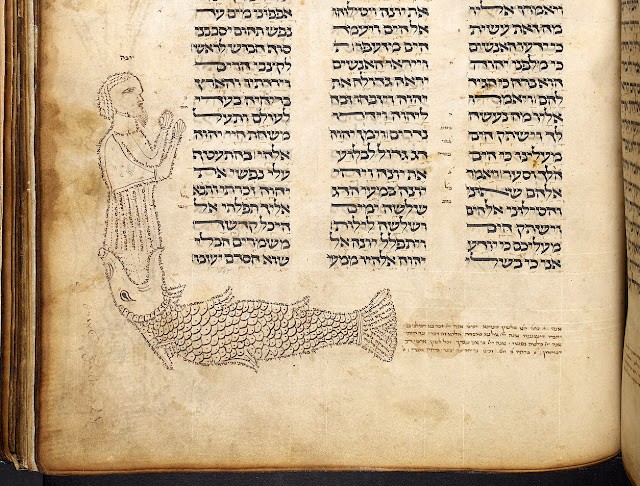
This Jewish Art Education program on “The Art of Ancient Hebrew Letters: Manuscripts, Mysticism, and Monsters” will focus on how Jews in the ancient and medieval worlds made the Hebrew letters go from mere vehicles of thought to being the very building-blocks of creation. Explore the earliest biblical manuscripts, ancient Hebrew carvings on synagogue walls and mosaic letters on synagogue floors, and end with monstrous and magnificent medieval manuscripts.
Additional sessions will be “Ben Shahn and the Art of Hebrew Calligraphy” on January 8, 2026 and and Feb. 26, 2026 on “Hebrew Calligraphy and Letter Arts Today: Tattoos, Type, and Graffiti” on February 26, 2026. No knowledge of Hebrew language required.
Joanna Homrighausen writes and teaches at the intersection of sacred text, lettering arts, and scribal crafts. Having earned her PhD in Religion (Hebrew Bible) at Duke University, she teaches Religious Studies at the College of William & Mary, where she has taught the biblical Hebrew sequence, the history of ancient Israel, and first-year writing seminars.
In November, Professor Homrighausen previewed her first talk for the BJV. Our conversation was edited for length and clarity.
You wrote that in your first program for us that you'll explore how Jews in the ancient and medieval worlds “made Hebrew letters go from a mere vehicle of thought to the very building blocks of creation.” Hebrew letters have meanings invested in them beyond the characters on the page – there are values, for example, assigned by gematria (the numerological system by which Hebrew letters correspond to numbers) so that words have different numerical, Kabbalistic values. So, can you explain what you mean about the building blocks of creation and calligraphy?
Hebrew language is this central, sacred, cultural touchstone of Jewish life. And so, consequently, Judaism has evolved some very creative and interesting ways to squeeze as much meaning and meaning-making out of the Hebrew language as possible. And so we have the texts that are in Hebrew, but we also have, like you said, traditions of Gammaetria. You can find numerical symbolism in biblical verses and get whole new homiletic meanings, interpretations out of it. And then when you get to the Talmud, and later and moving forward, you get discussions of the meanings of Hebrew words that are rooted in the shapes of the letters, like the visual look at the letter forms.
Why does the Torah begin with the letter bet? Well, it's open and it's closed on three sides. It has a roof and a floor, and it has one side that's open. And this is to represent that God made the world as a home for humans. And then, of course, there is the mystical stuff, the Kabbalistic ideas of creation through the letters of the Hebrew alphabet, which also goes way back in Jewish tradition. What I'm interested in thinking about and talking about is not just what is the meaning of the letters in the Kabbalah sense, but how do we look at them visually and appreciate that element? When we look at the visual dimension of the Hebrew letters and how they're written in all kinds of different media - from synagogue carvings to medieval manuscripts to Torah scrolls – how does the art of the Hebrew letter touch on so many parts of Jewish life?
There is so much care invested in scripture being recorded accurately. Did the added layers of meaning and significance free up calligraphers or constrain them?
On the level of playing with letter forms, I guess you could make an argument that there were constraints. So just for example, there's a large body of Jewish law about how to write a Torah scroll. And there's a good chunk of it that has to do with the way that you have to make letters because you don't want people to misread a Torah scroll when they're chanting on Shabbat. The letter reish cannot have a hard-edged corner. It must be pretty rounded so that you can tell it from a daleth. And the yud can't extend really far down the little tail at the bottom - otherwise, it'll look like a vav. I have a hunch that the tradition of having to hand-scribe things in Judaism kept calligraphy, kept the handmade lettering arts going. If you look at Western Christianity, that tradition of making major biblical manuscripts [by hand] went away after Gutenberg, more or less. I don't think [the Jewish tradition] restraining or opening. I think it's both. There are constraints, as with everything in Jewish life. There are communal norms that must be respected andd at the same time, within those norms, there's a lot of creativity that can take place.
So long as everything is kept kosher.
Yeah. Of course, we have to keep separate the world of playful Hebrew calligraphy, made by people like [the artist] Ben Shahn or someone like Gabriel Wolf, who's designing tattoos. There's a whole art calligraphy side of Hebrew letters of works that are not being made for communal ritual.
Let me ask about the other theme of your talk, about drawings that appear in the margins of a manuscript. I very much enjoyed Michael Camille’s excellent book about the marginal drawings in medieval Christian manuscripts, Image on the Edge. One reviewer described edges, margins, boundaries, and liminal zones as spaces where order can and does break down. These marginal images don't usually stand alone, but in relation to and commentary upon a larger image or the text itself. Do margins serve Jewish artists in the same way as Camille described them serving in Christian manuscripts in the Middle Ages?
Marc Michael Epstein, who teaches at Vassar, applied a lot of Camille’s ideas to medieval Hebrew manuscripts, like Haggadahs that have Jews with the heads of birds and things like that. He argued that Jews were adopting the dominant cultural symbolism and illustrating scenes of daily life and of biblical memory in ways that could bring it into their own time, that also might be making comments on the place of Jews in Christian society. I think with any book form, there's always this dialog between the “main text” and the margins. The margins are where we play. I think of a page of Talmud, where there are always a lot of different voices on the page.
I have an essay in the new Jewish Publication Society book, Ketubah Renaissance, about the contemporary revival of the hand-decorated ketubah that's taken place since roughly 1970. I write about how a lot of these ketubot have the legal text in the center. What's in the margins might be something very idiosyncratic and custom-made for a particular couple. I would wager to bet for a lot of Jews, especially Jews who are not as invested in traditional forms of halakhah, might not even know what the legal text in the middle means. The text is a set tradition, but maybe symbols around the periphery that they've chosen in the margins tell us something about what the couple values or what their story is as a couple. So in that case, the margins are saying more or mean more to some people than the actual text. So – what's the text? What's the margin? What's the center? What's the periphery? I think these are getting played with.
Marc Michael Epstein has definitely argued that there is social commentary going on. But it's veiled and submerged because, of course, if a book gets into the wrong hands, you might attract persecution.
How are your three programs going to connect? “Ben Shahn and the Art of Hebrew Calligraphy” will be the next one in January and then “Hebrew Calligraphy and Letter Arts Today: Tattoos, Type, and Graffiti” in February.
All three of them will use the art of Hebrew calligraphy, lettering, typography, all of those things, to open up different visions of Judaism and show how this art form connects to different parts of Jewish life – whether it's law, ritual, whether it's ideas about mysticism, and all the different ways the Hebrew alphabet is meaningful and is made meaningful. For the second talk, I’ll focus on Ben Shahn. His letters were very playful and very clearly embrace a handmade folk esthetic, with all its imperfections and messiness. That for him was part of his Jewish vision because he was so invested in social justice. And in the third talk, I'll be looking at things like Hebrew tattoos, and how different typefaces have taken on different cultural associations, especially like in Israel. There are typefaces that are for religious books, but there were, for example, in the early years of the Nation State of Israel, an interest in making typefaces that would express Israeli national identity. So I’ll be discussing all of these things that letters are doing beyond just conveying words.