
Rabbi Reflection
By Rabbi Neal I. Borovitz
Historically, the greatest threats to Jewish survival have been antisemitism and assimilation. The first quarter of the 21st century has been a moment when we are facing challenges to Jewish continuity from both of these forces at the same time.
Two of the most celebratory festivals on the Jewish calendar, Purim and Chanukah respectively, commemorate moments in which the Jewish People successfully defended against these forces. Both the Book of Esther and the Books of the Maccabees are stories of Jews successfully standing up to tyrants. Both books tell a story of overcoming threats to Jewish communal survival.
The Book of Esther, which we are commanded to re-read annually on the forthcoming festival of Purim, is the only book of the Bible in which God is not explicitly mentioned. (Though no name of God appears in Song of Songs, both Jewish and Christian commentators over the ages, see the entire book as an allegory of the love relationship between God and a covenantal People). The only mitzvot associated with Purim are the commands to hear the reading of the Scroll of Esther and to celebrate the victory over Haman. The heroes of the story, Esther and Mordechai, are clearly described as assimilated Jews. The book's acceptance of intermarriage stands in opposition to the position found in the Books of Ezra and Nehemiah which, like Esther, are set in the time of the Babylonian exile.
The 1st century CE rabbis who included Esther in the Bible canon declared that certain Jewish books, including Maccabees, were to be “forbidden literature.” There is no Hebrew edition of Maccabees that has survived. It is only through Christian sources in the earliest Greek and Latin Bibles that the actual text of the Chanukah story is available to us.
I hold to the theory held by many Jewish Biblical scholars that the Book of Esther reads more like a diaspora novella than a historical report, in contrast to the Book of Maccabees which is considered by Jewish and Christian scholars to be historical.
To me, the fact that there is clear evidence that the Chanukah story found in Maccabees is historical, while the Purim tale is most likely fictional, choosing to include Esther rather than Maccabees seems on its surface to be an unusual choice.
However, if we put ourselves into the seats of the post 70 CE academy of rabbis who are credited with the codification of the Hebrew Bible and were the first generation of rabbis who created the Mishna and Talmud, perhaps excluding Maccabees, was intentional, because of the concern that the full story of Maccabees which was an inspiration for both the rebellion against Rome in 66-73 CE and the later Bar Kochba rebellion of 135 CE could encourage future rebellion. It is likely that the popularity of the celebration of Chanukah led these early rabbis to, instead of placing The Book of Maccabees in the canon, to retell the Chanukah story through the creation, in Talmudic, Midrashic and liturgical literature, of a story where God has the prominent role in a winter solstice Festival of Lights.
Chanukah and Purim share an important place in the communal life of Jewish communities over the last 2,000 years. They are both stories of hope that Judaism and the Jewish People can survive the efforts of those who seek our disappearance through either annihilation or assimilation.
Chanukah is the story of a group of Jews who revolt against a Hellenistic culture which “ONLY" wants the Jews to assimilate, and forsake their particularistic practices. It is in fact as much an internal Jewish civil war as it is a war against the occupying force of Antiochus. However, the story is told in a manner that inspires zealotry. This past year, I re-read both the Book of Maccabees and the account of the war with Rome of 66-73 CE by the Roman Jewish historian Josephus, which awakened me to the danger we face from divisive strife within both Israeli and American Jewish communities.
In the Purim story, the threat is clearly defined as a defense against an enemy who seeks Jewish annihilation, despite the fact that the Jews described for us in the story are already highly assimilated. Pleading with Esther as he pleads with her to intervene with her husband the King to stop Haman, Mordechai warns her that antisemitism is a societal cancer against which no Jew, no matter how accepted he or she is in the larger non-Jewish world, is immune.
Assimilation and antisemitism remain for us today real threats to Jewish survival, individually and communally. Purim is a moment in which we American Jews – and particularly we the members of the Berkshire Jewish community – can take pride while rededicating ourselves to the efforts to combat BOTH antisemitism and assimilation. We must meet these challenges while taking to heart the lesson of our ancient rabbis who reinterpreted the story of Chanukah, so as to not allow our desire for religious liberty and pursuit of our rights lead us to a zealotry of superiority.
Rabbi Neal Borovitz is the Rabbi Emeritus of Kol Dorot, a Reform Jewish community in River Edge, NJ, where he served from 1988-2013. Rabbi Borovitz is an active leader in community affairs. He is a past chair of Jewish Community Relations Council of Northern New Jersey; the North Jersey Board of Rabbis; former Vice Chair of Jewish Council for Public Affairs, as well as the founding chairman of the Jewish Learning Project of Bergen County. He is a frequent contributor to the Jewish Standard of New Jersey and the Times of Israel. Rabbi Borovitz continues to teach adult education at Kol Dorot and at Stephen Wise Free Synagogue in New York City and has been an active member of The Berkshire Minyan in Great Barrington for 20 years.
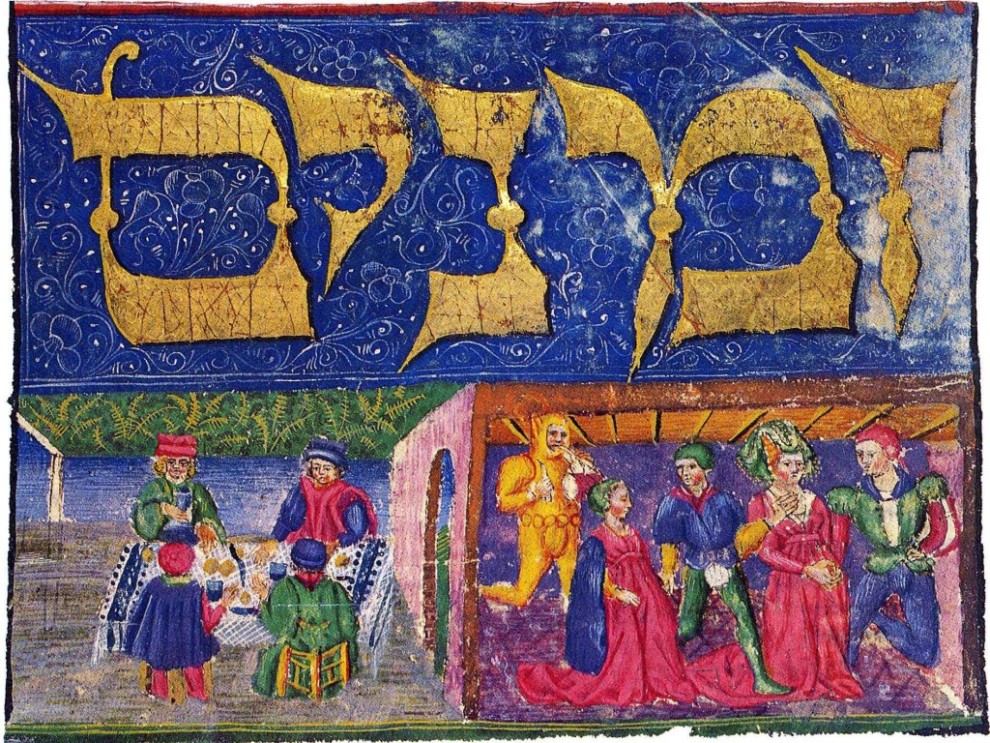
Image: The earliest depiction of people wearing costumes on Purim, from Sefer Zemanim (the Book of Holidays), in Maimonides’ Mishneh Torah. Original in Vatican City, Biblioteca Apostolica Vaticana. From northern Italy, ca. 1470.