
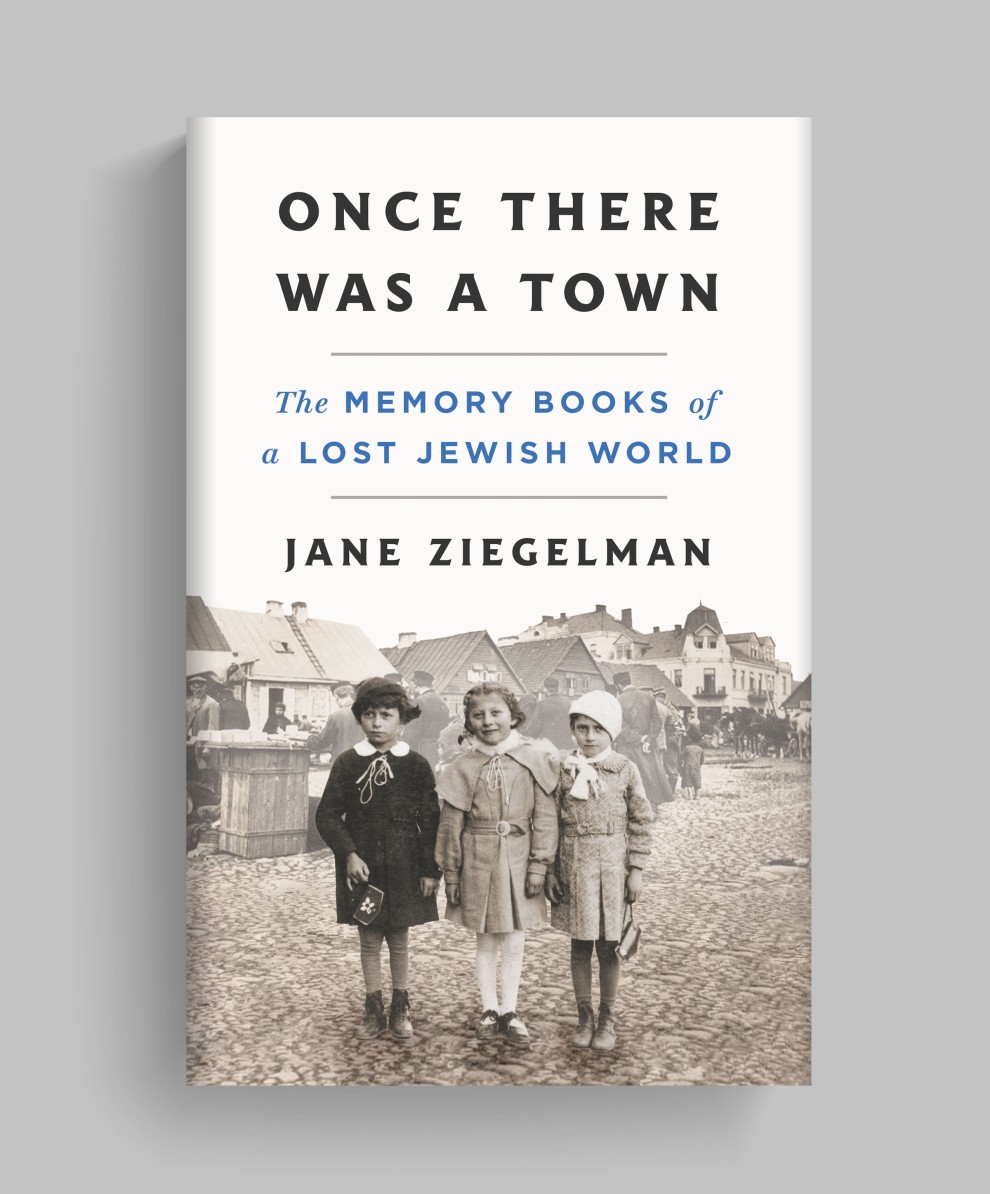
Author Jane Ziegelman unlocks the history and humanity contained in post-WWII yizkor books
By Albert Stern / BJV Editor
Yizkor books are commemorative volumes produced in the decades following the Second World War to memorialize the Jewish communities erased during the Holocaust and the lives of those who perished. Compiled and published mostly in Israel and the United States by mutual aid societies established by a town’s emigrants (landsmanschaft), the books are stuffed with history, reminiscences, profiles of eminent townspeople, poetry, maps, artwork and photographs, accounts of the community’s demise, long lists of the dead, and survivors’ stories. Although regarded by many professional historians as the sometimes not-entirely-reliable work of amateurs, yizkor books contain a motherlode of information about Jewish life in Eastern Europe that no longer exists anyplace else.
While yizkor books serve as a foundational component of Jewish collective memory, they also have played a role in the collective forgetting of our European past. According to Jane Ziegelman, author of a remarkable new book, Once There Was a Town: The Memory Books of a Lost Jewish World, the elders in some families frequently concealed yizkor books from their children and grandchildren, an expression of their desire move past the trauma of the Holocaust and to shield the next generations from its grim reality. Written mainly in Yiddish and Hebrew, yizkor books are also likely to be impenetrable to readers of other languages, although translating them is an ongoing historical project that conceivably could be streamlined by the use of AI.
My family was one of those who kept their hometowns’ yizkor book under wraps (and shielded the children from our Holocaust narrative), even though members our extended family appear throughout its pages as contributors, as well in the lists of victims of Nazi atrocities. My maternal grandfather was from the then-Polish (now Belarusian) town of Luninets and my grandmother was from Kozhan-Gorodok, a smaller village nearby. They emigrated to New York before World War I and were actively involved with their towns’ landsmanschaft in America. When I first encountered our yizkor book about 10 years ago, I was stunned to find out that my grandfather, Harry – a man chiefly recalled in our extended family as having been a sickly, remote, and heartbroken man – had been the person entrusted by his emigre compatriots to bring relief funds collected in America back to Luninets after WWI. He is described as being a savior whose mission rescued the community from starvation. After World War II, he was part of the committee that aided survivors – there were not many, as the two towns were among those annihilated in 1941 by the Einsatzgruppen killing squads during Operation Barbarossa – and published their yizkor book in Tel Aviv in 1952.
You think someone in the family might have mentioned that, but no. I was given a thoroughgoing education about the Holocaust even as my own family story was obfuscated by omission and mistruths. Reading our yizkor book transformed my understanding not only of my family history, but of my own life and family dynamics. (I thought they acted as they did because they just didn’t like me – but no, there was this Holocaust grief and survivors’ guilt thing going on that I had no way apprehending as a child.) Perhaps similar types of revelations await you, as well – if your ancestral communities produced a yizkor book, it is likely to be digitally archived and perhaps at least partially translated in the online collections of JewishGen.org, the Yiddish Book Center, and the New York Public Library, among other repositories. By all means, I encourage you to investigate if you haven’t already.
And when you do, you will find that Jane Ziegelman has provided with a superb introduction to yizkor books that also works as a rich but concise overview of everyday life in a shtetl and as an affecting personal memoir (her family, not all of whom made it to the United States, was from Luboml, then in Poland and now in Ukraine). Ziegelman – author of the acclaimed Lower East Side history 97 Orchard – is a fine prose stylist whose descriptions of domestic life, market day, street life, worship, food, shtetl Shabbats, the cheder classroom, and Zionist idealism at times absolutely sing. But her keenest authorial decision was to structure Once There Was a Town by adapting the conventions of a typical yizkor book – it starts with early history and moves through shtetl daily life, folklore, politics, conflicts with non-Jewish neighbors, annihilation, and finally survival. After finishing her narrative, you will understand how our forbears chose to tell their stories to themselves and record them for their descendants; that, in its way, is as meaningful as the stories they told. The books reveal so much about the way Jews processed the lost Jewish world in the immediate wake of the catastrophe and offer a snapshot look at how they were starting the hard work of creating a new one in Israel and the Diaspora.
“Yizkor books are very much about places and the idea of place,” Ziegelman writes. “You could also say, however, that they function as places themselves.” They are what we have left, and I predict that Once There Was a Town will further unlock the worlds and lives and multitudes contained in their pages.
In January, Ziegelman spoke to the BJV about Once There Was a Town. Our conversation has been edited for length and clarity.
Explain what Yizkor books are and the place they hold in our collective memory. Given that these books were sometimes hidden away by elders who didn’t want to expose their children to what happened in the Holocaust, what part do they also play in our collective forgetting of Europe?
Historically, the Jewish response to disaster has been to write about it – a tradition of what's called “disaster literature,” starting with the Old Testament Book of Lamentations, which documents the destruction of the temple in Jerusalem. In the Middle Ages, there's another type of disaster literature called memorbucher, which are records of these killing sprees that took place during the Crusades in medieval Germany. And there are more examples as the centuries go on. Yizkor books belong in that tradition of documenting and remembering disaster. This is part of who we are as Jews. Yizkor books were written in the decade, starting in the 1940s. So very early, in the decades after the Holocaust, fellow townspeople came together in groups to commemorate their towns or their shtetls. And they are both records of the destruction of the shtetls and – this is the part of the story that I emphasize – what came before the destruction. What was so captivating to me is the before.
The larger question of collective forgetting, as I'm beginning to understand it, was that there was a period when the Holocaust was too close. The pain was too raw to engage in intensive remembering. We're gaining distance now. We're also losing witnesses. We're losing our shtetl Jews. My father is 98. In fact, his birthday is this weekend. He's among that generation. And I think there's a sense now among people of our generation that time is running out, and we have to save the memories of this world that was destroyed. We’ve reached a point where it's time to remember with purposefulness.
I'm going to read you a bit of writing you're probably going to recognize. “Standing over the grave, one feels sure that terrible things have happened here. The ground still looks freshly tamped, it looks uncomfortable. I am standing on the very spot where the war happened, where history exploded, and it's my history. To dream that the ground was heaving doesn't seem far-fetched.” That is what you wrote in 1991, after you visited Luboml. So you’ve been writing about this and thinking about this as a writer for more than 35 years or 34 years. How did you, from the point you started, process the family story and the historical story the point where you put together Once There Was a Town?
Some of my earliest childhood memories are of hearing stories about Luboml, particularly stories that were told by my father. The fact that he was an immigrant Jew from this little town who became a very successful businessman was a very important part of his self-mythology. Stories about Luboml were always in the air. When the family got together, I felt the presence of this town in the room with us. It was palpable. And I knew something bad had happened there. I didn't understand what it was as a young kid. As my knowledge grew, I understood that the Holocaust had taken place. I knew that Luboml was part of that story, but I didn't know in what way. I always wanted to ask questions about Luboml. I remember interviewing relatives as a kid with a cassette tape recorder. ‘Tell me, what did you eat? Tell me, what games did you play? Tell me, what was your house like?’ I always wanted to understand this place that haunted me. And discovering the English translation of the Luboml yizkor book that came out in 1997 was like the answer to a long-held dream. Finally, I'm going to know this place that has played such an important part in my family's history and in my own sense of self, in my own identity.
Yizkor books are unflinching in terms of what life was like before the Holocaust, particularly in terms of the poverty and the harassment by the hooligans who lived alongside the Jews. But when you write about the good parts of life, as in the section the importance of Shabbat and of the salty, fatty foods they ate for their Shabbat meal, your tone captures a fondness the yizkor book writers must have still had for life in the shtetl. How much about that life do you think was sentimentalized by the contributors?
No doubt there was sentimentalizing. Yizkor book writers were deeply self-aware. They knew that they were sentimentalizing, and some even acknowledge that they're writing in an elegiac mode. A yizkor book was a place to remember what was difficult, but also what was beautiful in this ‘luminous civilization,’ which is a Cynthia Ozik phrase and a beautiful description. Yes, there was sentimentalizing, but the idea that that would happen was very much in the consciousness of many of the people who wrote these books.
It's small town life. I mean, think of our own perceptions of small-town America, of the sense of community and of connectedness. Well, that was very much part of the shtetl as well. So there's a degree of sentimentalizing, but also there's a large degree of truth. These were tight-knit communities, what anthropologists call face-to-face communities, where people knew each other in a way that they don't in my neighborhood in Brooklyn Heights. I think, that those feelings were part of the reality of what a shtetl was.
How can people connect with Yizkor books to help form a contemporary Jewish identity or sustain a certain kind of historical Jewish identity? How might they be useful in processing what's going on today, in our own Jewish lives?
Well, the beauty of it is that yizkor books are much more accessible than they were 20 years ago. The JewishGen’s database that hosts the yizkor books was originally a genealogical website – and that's primarily what Yizkor books were used for. People used those necrologies at the back of yizkor books in as important genealogical tools. Users didn't really pay much attention to the content of the descriptions of the world that was being conjured in the yizkor books. Now that's beginning to change. People are beginning to read the rest of the yizkor book, not just the necrology. What that did for me is show that for my ancestors, as we were saying, life was immensely hard, filled with challenges, material, psychological, economical, but that shtetl life was punctuated by these flashes of almost transcendent beauty.
Part of it were things like the traditional ways of honoring the Shabbat. That flash of beauty that you received on Shabbat is what sustained you for the rest of the week. And I guess the idea is, let's look for those flashes the way our ancestors did and let's find them in our own Judaism. I mean, there were elaborate structures that were established in the shtetls for helping the poor and the wandering peddlers and beggars, a substantial charitable network set up where people really did take care of each other. This is a Jewish impulse with historical roots, and it's perpetuated today. This is a great thing to know about ourselves and so commit to more of it.
You said that when we first started speaking, how Jews response to tragedy has been to write about it. In the yizkor book of my village, there is a whole section of descendants or people from these villages, who fell as soldiers in Israel’s 1948 War of Independence. To me, it shows how much these postwar survivor communities connected the struggle to establish a homeland with what happened in the Holocaust. They were not two things. They were all part of the same thing. Is that a correct way of looking at it?
I'd never put it together that way, but I would say yes, that's accurate. In the yizkor books, you also see where Zionism started and how it started and what it meant to people who felt they were living in exile – and how far, I believe, that we've straight from the roots of Zionism as it was forming then in Eastern Europe.
In your book, you share how there were kibbutzim in Poland, which I was only dimly aware of.
Those kibbutzim really agrarian socialist communities. That's what people were dreaming of. That's not exactly what Israel is today, but it was a very altruistic vision of a way that Jews could live. I think I put this in the book. There's a section where a guy is working on one of the kibbutzim in Poland, and he talks about the energy that he feels coming out of the Earth as he's working. So that was also part of Zionism, that deep connection to Earth and nature. That, for me, was revelatory.
So, about survivor's guilt. I know it very much permeated my family and out of a lot of other families I knew. I grew up in Miami Beach, where there were a lot of survivors, a lot of people who had lost a great deal, and that included my own family. How much does that sense of survivor's guilt permeate the yizkor books that you have read, or was that something kept closer to the vest?
It was kept closer to the vest. It was something that I became interested in, actually, after I finished the book, where I started doing searches for exactly that, for people expressing remorse skills over things they should have done. Why are they alive? Why didn't they go back to the house that third time or a fourth time and take their little sister? Questioning why they were alive and their families weren't. But I feel, again, that in the time period that these books were written, it was too soon, historically, to go to that place in a public in a way to bring light to such dark feelings. The pain was too intense.
I know I've recently I had a conversation with my aunt. FYI, I'm secular, but the rest of my father's family are all deeply devout. I didn't actually ask her if she ever feels guilty, but she said ‘Sometimes I wonder, Why me? Why me? Why am I alive? And then I look at all my children and my grandchildren, and they're studying Torah. And I think, Okay, maybe that's why.’ And that was the way she answered it – she was saved to save Torah through the devotion of her progeny.