
A “Bully!” program with Professor Andrew Porwancher
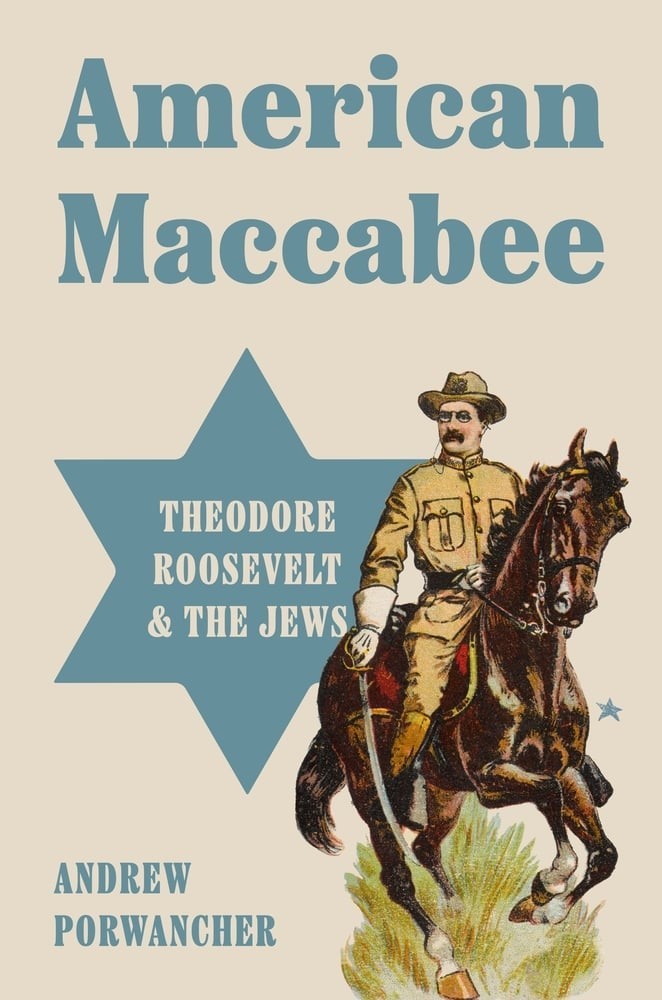
On Thursday, March 26, at 7 p.m., historian Andrew Porwancher will discuss his book, American Maccabee: Theodore Roosevelt and the Jews, which explores the complex and often surprising relationship between the 26th US president and the American Jewish community during a pivotal moment in U.S. history.
The program will be presented via Zoom. Register at the calendar of events page at jewishberkshires.org.
Porwancher will examine how Roosevelt, a scion of the Protestant elite, became an unexpected ally to Jewish immigrants arriving in large numbers at Ellis Island. From his early political career in New York, Roosevelt forged relationships with Jewish communities that were unprecedented for a future president. He spoke frequently on the Lower East Side, advocated for reform in sweatshops where many Jewish laborers worked under dangerous conditions, and publicly praised the heroism of the Maccabees, holding them up as a model for American Jewish life.
The program will also address the contradictions in Roosevelt’s record. During his presidency, he was confronted with the brutal persecution of Jews in Eastern Europe, which sent waves of refugees to the United States, even as antisemitic and xenophobic sentiments were growing at home. Drawing on new archival research, Porwancher will present a nuanced portrait of a leader whose engagement with Jewish issues reflected both moral conviction and the limitations of his time.
Andrew Porwancher is professor of history at Arizona State University. He is the author of The Jewish World of Alexander Hamilton and The Devil Himself: A Tale of Honor, Insanity, and the Birth of Modern America.
The BJV Interview: Andrew Porwancher
By Albert Stern / BJV Editor
In January, Professor Porwancher spoke to the BJV about some of the themes of his work. Our conversation was edited for length and clarity.
Describe Roosevelt’s relationship with the Jews of the Lower East Side during his time as police commissioner of New York City and later as the governor of the state. Also, did he have similar relationships with other immigrant ethnic groups?
Roosevelt, as police commissioner, began forging this deep bond with the Eastern European Jewish immigrants who were then flooding the Lower East Side. He barnstorms that neighborhood, going block by block, giving speeches to crowds made up of Jewish newcomers who had come to hear the young commissioner espouse his egalitarian ethos. He assured them that, contrary to the rule of Tammany Hall, the Democratic machine that had sold out rewards and patronage based on spoils and connections, that they were entering a merit-based society where a Jew of talents and work ethic who had no particular connections would be treated - they would be given a square deal, to put it in Rooseveltian terms. I have not made a special study of Roosevelt's relationships with various other ethnic groups, but I caught hints of it in my research. I believe that he also cultivated Irish and Italian constituencies with comparable vigor.
His rise was meteoric. From New York City police chief to assistant secretary of the US Navy to hero of the Spanish American War to governor of New York to vice president in less than ten years. Then, he was thrust into the presidency at age 42 following the assassination of William McKinley. He did so at a point of history that you describe this way: “His mixed approach to Jewish affairs aptly reflected a nation uncertain of its own destiny.” Can you expand on that a little bit?
America was not yet the dominant global superpower that it would become amid the ashes of the Second World War, but neither was it the fledgling young nation on the margins of European Empire that it had been at its inception, a century before Roosevelt's political ascent. America in the Rooseveltian era was becoming an increasingly important player on the global stage and starting to project its power beyond its shores. At the same time that America is playing an ever increasingly important role in the global arena, the country is growing ever more diverse. It is drawing immigrants, not just from the Northern and Western European countries that had traditionally funneled migrants to the New World. Southern [Europeans] and Eastern European Jews were coming in unprecedented numbers. America was dealing with these twin challenges in an era of globalization. That is the broader backdrop against which Roosevelt's Jewish diplomacy abroad, as well as his relationship with Jewish immigrants at home, takes place.
After the Spanish American War America starts to establish itself as an imperialist country. Yet at the same time, the borders are still open to new immigration. How did he reconcile this outward-looking imperialist program with the waves of immigrants changing the demographics of America?
Well, the case of Jews shows how counterintuitive the political logic could be at that time, because there were antisemites who supported a robust role for America in helping attenuate antisemitism overseas. Their motive was less humanitarian than it was to stem the tide of immigrants. What they really wanted was to suppress the catalytic force abroad that was pushing so many Jews into American ports. There are ways in which – counterintuitively – xenophobia and a more robust vision of America's place in the world could go hand in hand. That's not to say that every reactionary favored an interventionist foreign policy, nor does that mean that pacifists necessarily shunned immigrants. But it is difficult to know someone's views on immigration, and from that, deduce with confidence their views on American foreign policy.
You characterize Roosevelt as somebody who held some of the prejudices of his era and of his class against the Jews. But you also make it very clear that above all, TR was a believer in pluralism. He was a believer in the melting pot, which often ruffled the feathers of some of his Jewish supporters. Were those ideas reflective of a broader consensus among the American public, or did Roosevelt, through his rhetoric and his actions, make that idea, the melting pot, more central to how America saw itself and its society?
Roosevelt, undoubtedly, helped strengthen the cultural premium on America as a melting pot. Roosevelt was a figure of really unparalleled influence in American history at his prime. Roosevelt was very involved in helping boost certain literary voices who championed the idea of America as a melting pot, not just Israel Zangwill [the British-Jewish playwright who penned the hugely popular interfaith romance The Melting Pot], but also other Jewish immigrant writers. I have no doubt that Roosevelt's efforts, public and behind the scenes, were central to amplifying those voices who endorsed this assimilationist view of America. Yet, at the same time, Roosevelt is in tension with himself because he also, at times, articulates a much more pluralistic vision. When he heralds the Maccabee warriors as a model for American Jews, he is not saying that Jews should eschew their cultural heritage as the price of participation in American society. He is not calling for their total homogenization. Rather, Roosevelt is suggesting that Jews should honor those parts of their own heritage that accord with his own premium on vigor and valor. I think that it is undoubtedly true that Roosevelt played a significant role in amplifying voices that endorse the melting pot, and yet he also contradicted those voices. As you know from reading the book, it is consistently Rooseveltian for him to articulate one idea and then contradict himself in short order.
Much of your book involves Roosevelt's response to the deadly pogroms in Russia that started with Kishinev in 1903 and then escalated. As you show, he had a genuine fear that a forceful diplomatic approach might make things worse for the Jews in Russia. In a certain sense, what followed was a success in that it helped open the doors of the United States to more Jewish immigration. But generally speaking, do you think that was the appropriate approach to that situation?
Oftentimes, the electorate will judge a president based on whether they think something is going well or poorly based on their own subjective sense of what counts as good and what counts as bad. But the reality is that the policymaker-in-chief often finds themselves choosing between a bunch of suboptimal choices. We see with the Kishinev petition, Roosevelt uses the formal channels of diplomacy to call on the Tsar to protect the lives and liberties of his Jewish subjects. It is true that there were pogroms that took place after that intervention. Might there have been more pogroms, and could they have been a greater scale but for Roosevelt's intervention? Alternatively, did Roosevelt's intervention foment more pogroms? It’s hard to know how the counterfactual would have played out.
Ultimately, I think that the central authorities in St. Petersburg did have agency for much of Roosevelt's presidency over what was happening in the provinces. I strongly suspect that America's public reproach of Russia over the pogroms probably made some headway in pushing the Tsarist regime to abstain from even greater violence than was perpetrated because America had basically impugned Russia's honor and credibility on the world's stage by holding up a mirror to Russian barbarity for the global community to see. Could Roosevelt have done more? Could America have sent troops to Russia? I don't know. It is difficult to go to war in a sustained way without the support of the American people for boots on the ground. That is true today, and it was true at the time. When you measure Roosevelt's intervention, against the non-action of other world leaders, Roosevelt was willing to boldly defy international norms that frowned on an American president – or any world leader – making a humanitarian reproach against a barbaric empire like Russia. Roosevelt does become the only head of state in the world to speak out publicly and condemn the Kishinev pogrom.
One of the things that your book brings out was just how organized the Jewish community was and how appalled they were by the news out of Russia. It reminded me so much of the post October 7 response. Were Americans very engaged with this story?
The American Republic was remarkably engaged with these questions of Jewish survival abroad. There were mass protests of Jews and Gentiles alike that pleaded with the president to intercede. These protests took place not just in the obvious locations with large Jewish populations like New York and Chicago, but also places like Texarkana. There is a group of Black lawyers in Louisville who hold a protest meeting against the violence visited upon Jewish victims in Russia. You have a Chinese theater in New York City hold benefit performances to funnel money to Jewish victims overseas. Newspapers - and not just major papers like the New York Times, but small-town papers – were informing their readership about developments with Roosevelt's Jewish diplomacy. When you look at just Roosevelt's records himself, these issues of Jewish diplomacy are part of State of the Union addresses, nomination speeches when he's running for President, campaign platforms. These issues were at the very center of American politics.
You write that in the 7.5 years of his presidency, America’s Jewish population doubled from one million to around 2 million. Did that influx change American perspectives of Jews and were they well received during that time period?
It was really a mixed bag. The Jewish population that predominated before the wave of program survivors came to American shores had been Jews, largely from Central Europe, who, by the era of Roosevelt's presidency, had become assimilated, Americanized, and very successful. The indigent Eastern European Jews who were fleeing persecution, cut a very a different figure from their more patrician Jewish counterparts. Some Americans embrace these newcomers. There was a strain of Protestantism known as Social Gospel Protestantism, a variant of Christianity to which Roosevelt subscribed. It called on Christians to operationalize their faith by extending their hand to the needy and to the newcomer. Those people embraced these Jewish immigrants and saw in these steamships full of Jewish survivors of the future, future proud American citizens.
Others shunned these immigrants. They feared that America's racial purity would be contaminated by this influx of Jewish blood into the body politic. They were aghast at the overcrowded slums to which many of these Jews and other immigrants were shunted, slums that were hotbeds of disease and filth. There were many of the white Anglo-Saxon patrician class who shuddered at these Jewish newcomers, and nor did they thrill the more affluent assimilated Jews trying to gain entry to their summer clubs and social resorts.
Partly because of the efforts of Jewish-American leadership to avert xenophobic legislation, and partly because of Roosevelt's willingness to lend his imprimatur to the cause of American inclusivity, we see an America that is remarkably hospitable to Jews, especially when juxtaposed to their treatment in the Old World. And yet, the era after Roosevelt would become something of a heyday for xenophobic antisemitism, as America in the 1920s institutes quotas that closes its doors to many Jews who are seeking to escape habitual bouts of butchery overseas.
You portray Teddy Roosevelt as a man of contradictions. After he died, when he was eulogized, especially in the Jewish community, they tended to remember the good things he did for the Jews, and not to mention the things that they didn't like. Do you think there's any lesson for current political climate in just accepting the fact that politicians, have very difficult jobs and that there are going to be inevitable contradictions?
Well, one lesson that we can take from the story of Roosevelt and the Jews is that in our democracy, the public matters a lot. Roosevelt was able to take a defiant stand against the Russian Empire on Jewish issues because he had the backing of the American people. To be sure, there were countervailing forces from diplomatic norms to folks at the State Department who were less sympathetic to the plight of Jews overseas.
But there was this tremendous force pushing Roosevelt to take a humanitarian stand on behalf half of embattled Jews, and that was the American people. We often get the political leadership that we ask for. I think if the American people have the courage to demand more of our political leaders, it’s in the nature of representative democracy that those leaders will be responsive to that public. In many ways, I think this book is a testament to the power of ordinary people to push American political leadership to do the right thing when doing the right thing is hard.