
Yossi Yovel on his study of one of nature’s most mysterious and remarkable creatures
By Albert Stern / BJV Editor
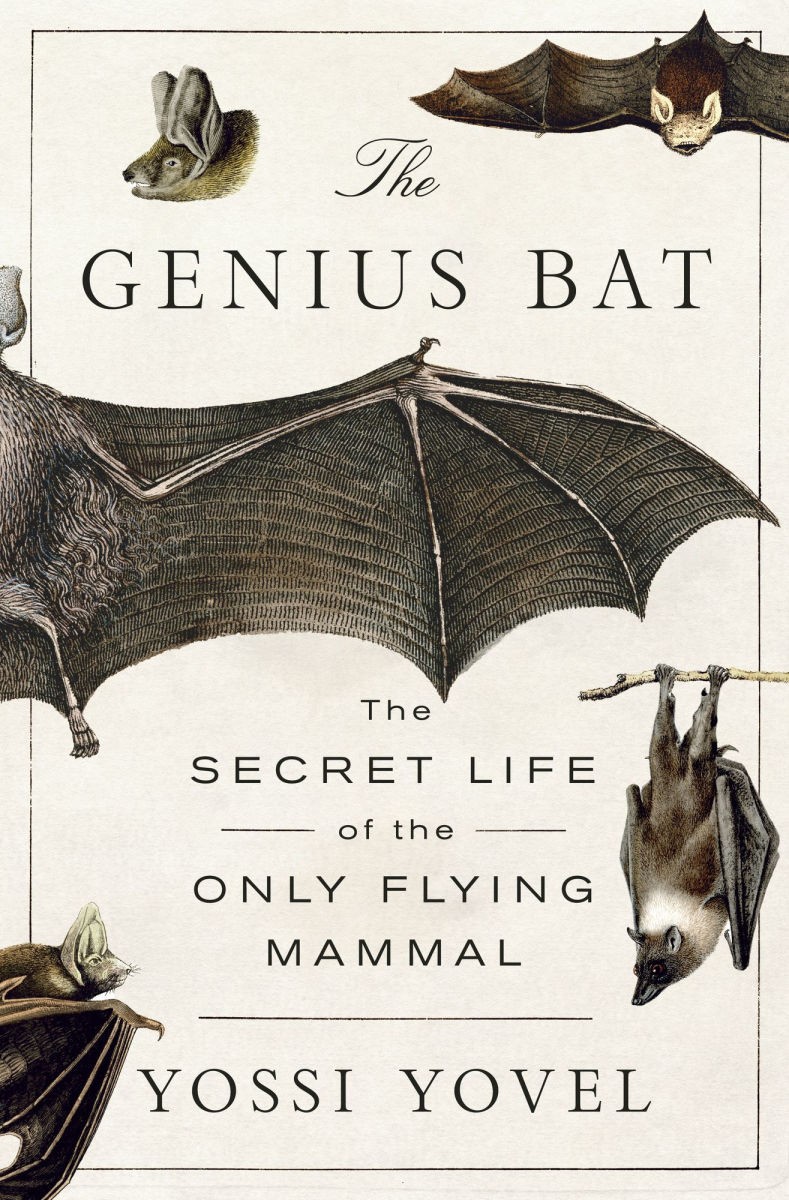
With The Genius Bat: The Secret Life of the Only Flying Mammal, Israeli ecologist and neurobiologist Yossi Yovel has written an engrossing book about bats for the general reader that focuses on exclusively on bat science, without touching on the bats in lore, literature, and the human imagination. The “heroes,” as Yovel characterizes them, of the story are the researchers who, over the decades, painstakingly examined bat behavior to unlock the mysteries of the creatures’ social lives and their extraordinary powers of echolocation, the location of objects by reflected sound.
Yovel’s pioneering contribution to the field of chiropterology, the study of bats, was to use tiny GPS monitors (engineered by an Israeli startup, naturally) to track bat behavior – 1,000 of them on ten species, he writes, “in more than ten countries on every possible continent except Antarctica, all with one objective – to understand what it’s like to be a bat.”
Through fieldwork and experiments at his lab at Tel Aviv University, Yovel and his research team have uncovered fascinating insights into bat behavior, among them that “the bats pinpoint [a] target via an assessment of time rather than distance…[B]ats don’t care about the metric distance to the target but instead ‘see’ the world as a series of events in time rather than space when using echolocation. In other words, the bat stretches its legs forward and prepares to land when the target is a certain amount of time from it, regardless of its spatial distance. The experiment also showed that the pups are born with this perception. Their brain is wired this way from their first day. It turns out that to be a bat is to live in a world of time and not of space.” Professor Yovel and a team of researchers also demonstrated episodic memory and planning capacity in the wild Egyptian fruit bat, a high-level cognitive ability that had long been thought to be unique to humans. In the case of the fruit bat, the team showed that these fruit bats possess an array of abilities that allow them to plan foraging routes based on spatiotemporal (i.e., having both spatial extension and temporal duration) memories.
Insights like these are arrived at through patience, ingenuity, intrepidity, intestinal fortitude, and the willingness to learn from failure. (Yovel provides cautionary tales showing the pitfalls scientists invite when they become too locked in to a theory to permit contradictory explanations to be explored.) What make The Genius Bat so engaging is the arch sense of humor Yovel displays in describing animal research and the travails experienced by the dedicated people who devote their lives to it. For example:
This is a good opportunity to say a few words about bat bites. When handled by a huge human, all bats might bite, but not all bites are equal. Each species does it in its own way. There are bashful bats that bite you and immediately stop, as if shocked by their own behavior. There are some minuscule species that try to bite but their teeth are too small to penetrate the skin, and there are great round leaf bats that simply lock their jaws on your finger and can only be dislodged with pliers. As a bat researcher, you can’t lose your cool when bitten. Briskly shaking your hand, as the brain implores you to do, may cause the bat to flee but it won’t advance your research. You have to remain calm as your finger is crushed between the bat’s sharp fangs and try to patiently extract it. One of the oldest techniques is to blow strongly on the bat’s face, and then pull your hand away quickly when it relaxes its bite for a moment. Unfortunately, this technique doesn’t work with Hipposideros armiger, a particularly skillful and relentless biter.
But we didn’t come to Thailand to study bites. We came to answer a question that occupied us in those years — the connection between the bat’s face and its echolocation signals.
The heroes of his book are chiropterology’s pioneers, researchers like Donald Griffin, Alan Grinnell, Ed Gould, and Hans-Ulrich Schnitzler who advanced the understanding of bats with far fewer technological resources than are available to today’s scientists. Yovel displays a genuine writerly flair in structuring his book, alternating episodes from their stories with anecdotes about his own research so that the narrative does not bog the general reader down in either historical or scientific detail. Yovel captures the personalities of these methodological obsessives with the acuity of a novelist, to the point that The Genius Bat works as well as an anthropological study of research scientists as it does as a study of bats.
Throughout the book, Yovel shares fascinating details about evolution, not only of bats but of other species, as well. The Genius Bat was named a ‘Book of the Year’ by the science journal Nature – a well-deserved accolade. In February, Professor Yovel spoke to the BJV about his work. Our conversation was edited for length and clarity.
The BJV Interview: Yossi Yovel
Your bio says you're an ecologist and a neurobiologist, “a rare combination of disciplines.” Can you explain what each of those disciplines entail and how they've informed your study of bats?
I like to say that actually ecology and neuroscience are, in a way, two sides of one coin, and they're connected through behavior – which is what I actually do, study behavior. Because on the one hand, neuroscience is interested in how the brain drives behavior, and ecology is interested in how behavior interacts with the environment. I think it's more about how you think and what are the questions that you ask. The language that we speak in the different disciplines is a different language. Neuroscience makes me much more mechanistic. I'm much more than an average ecologist. I'm always thinking about the details – how does the animal perceive the world, for example, or is it possible for the brain to even do this or that. In general, our work, I would say, is more in the ecological side because we do behavior in the field. But we try to ask questions that are of interest to neuroscientists. We do MRI studies of bats, and I would love to also go into the brain. But because I try to study the animal in a very natural context, that's often very difficult. We don't want to put electrodes into the brains of animals that are flying outside. So it is a challenge to think of how we might look into the brain, but the way we ask the behavioral questions are of much relevance to a neuroscientist.
Let me ask you an Israel question. How does the Israeli educational system encourage a young person interested in making bats his or her career?
I think it's more than the education system. It's the high tech, which is driven by the military strongly, of course. There's a lot of people coming from technological units, and a lot of them are developing technologies. This also creates a network of connections, and often you can talk to people who know stuff about things. A lot of our work heavily depends on the development of miniature sensors, which are not related to the army directly in any way. But I can say that a lot of the people who've been developing for us came out of technological units, and that's why they're so good with miniaturization of electronics, which is very hard. There's one more thing that I always say, we work very fast in Israel, whether it's developing a company or whether it's doing research. And I think it's a combination of how we're brought up, but it's our size - Israel is a small country. If I need to speak to somebody who's doing something, I will always within two degrees of separation, at most.
In the book, you write about how in the past – for example, during the development of radar and sonar – military people were very interested in bat research. Today, it’s also the people working on self-driving cars. What technologies will benefit from the kind of the research you're doing?
Let talk about civil applications for a change and to stay more on a positive side. Think about agriculture, something that we've been recently involved in. There's a lot of need for what's called precision agriculture. We're doing a lot of robotics to improve yield or to detect pathogens or whatever. We've done stuff that has to do with guiding robots in greenhouses, for example. We've worked with sound on echoes of plants to provide information about yield. Crops can often be dense and with a camera, you can't see enough. But sound waves can travel around objects, and they can just bring information from inside the vegetation. So that's one domain that has to do with sonar-related applications.
Another direction would be learning from how bats behave. We know that bats are very efficient in searching for insects. So maybe we can learn from their movement, from their social movement, how they move in a group in order to improve searching algorithms. And of course, there's also a whole other avenue, which I'm not personally involved in, but people are trying to learn about extreme longevity. [Note: Bats are extremely long-lived, particularly for an animal of that size – bats can have a lifespan from 15 to 40 years.] Bats have very unique physiology. They can hibernate. People are looking for the secret, the molecular secret of underlying these abilities.
One thing that surprised me is your pointing out that “Contrary to the prevailing view, genetics also placed bats in evolutionary proximity to predators and ungulates (hooved animals) and far from rodents. Thus, bats are not flying mice, and fruit bats are not flying monkeys. If anything, bats are closer to flying cows or wolves. In fact, humans are more closely related to mice than bats are.”
Yeah, what you see is not what you get. We are very used to thinking if it's a small and furry, it has to be a mouse, right? But it's not. There are a lot of small furry creatures that come from many, many different taxa, as we call it in phylogeny or in genetics. It's an interesting anecdote that actually we are more closely related to rodents than bats are, but it's not really a surprise. Again, we're just working too much with our eyes when we're looking at these animals. There's something that we call convergence in evolution, which means that animals of species that are not related at all look similarly or do similar things because they're coping with the same environment or the same problem. Dolphin echolocation and bat echolocation is one of the famous examples. So somebody could say, oh, maybe dolphins and bats are closely related because they both use echolocation, right? But we know that that's a convergent feature, not necessarily an indication for relatedness.
You write about AI and simulations, how researchers studying animal behavior are using artificial intelligence and simulations. What technology is the most promising for your field and what is the question about bats that you most would like that new technology help you answer?
I just listened to a podcast about the newest advancements in large language models, LLMs, which we sometimes call sequence predicting models. Chat bots are based on them. I’m super excited by the power that they give you looking into bat and or animal communication in general. Maybe we can use them to decode animal communication. One of my students is running a project where we try to explain or replicate bat navigation using one of these models. These models learn by observing a lot of sequences. They can be sequences of behavior, which is what we're trying to do. And in the past, I could not program a simple model by myself that replicates animal behavior. And now we can do this.
There's a number of new questions. I'm thinking we can have models interacting with each other, mimicking social behavior, or we could add another model that is in charge of communication. I could have different models, trends based on individual tendencies of different animals, which are things we see in the wild. All of these directions are completely new and super interesting. I can't say, ‘okay, this is the problem we want to solve with them,’ because I think it's more about exploring now. We have a new toy which is more powerful than anything we've ever thought of. And there's so many things that we need to discover. Another dimension is looking at these models and comparing their activation to how the brain works. There are really so many avenues and I think the researchers are going to take all of these avenues.
Editor’s Note: The Genius Bat also has a nifty Berkshires connection – it was translated from the original Hebrew by Berkshire native and friend of the BJV Ira Moskowitz, who now makes his home in Israel. Mazel tov, Ira –
you did a great job of capturing Professor Yovel’s voice and literary craft.