
By Rabbi David Weiner / Knesset Israel
Visiting London last summer, my son Joe and I visited the British Museum, which houses artifacts from across the ancient world, especially spoils of the former empire. We viewed the Parthenon Marbles, soon to be repatriated, and the extraordinary Egyptian collection, before exploring several upstairs rooms containing relics from ancient Canaan. But for me the highlight was the wing of sculpture and friezes from ancient Assyria. Guarded by colossal winged bulls with human faces and magnificent heads of long, curly hair, the recreated treasury and throne rooms of Nineveh and Nimrud were especially thought-provoking. Much of the Torah coalesced while our ancestors were living either under or adjacent to the influence of this first ancient empire, and some of the earliest archaeological corroborations for the stories our people tell sit in the Assyrian wing of the British Museum. It is hard to overstate the impact of living in the Assyrian Empire on our Israelite and Judean ancestors. In the same way that we are immersed in contemporary culture, our ancestors were enveloped by Assyrian language, laws, iconography, and culture.
Life in the Assyrian Empire inspired the content and discourse of the book of Deuteronomy, which we read each summer in synagogue. The Assyrian emperor related to his vassals through covenants, promising protection and prosperity in exchange for obedience and fealty. He wrote laws that subjects were to adopt and follow, with blessings the consequence for obedience and curses the risk of rebellion. The Assyrians kept treaty and covenant documents in prominent places like the throne room of the king. Throughout, the emperor unfailingly presented himself in Akkadian as ‘šar kiššati’. In English, that phrase translates to, ‘king of the world,’ and, in Hebrew, to ‘melekh haolam.’
The Torah, especially the book of Deuteronomy, adopted much of the Assyrian imperial idiom but subversively transformed it into a uniquely Israelite religious and political vision. Our ancestors reframed the ‘king of the world,’ demoting the emperor of Assyria in favor of a transcendent God. They taught that covenant, law, and moral authority flow not from human whim but from a very powerful deity who cares deeply about justice and the plight of the vulnerable. The people of the covenant are called to aspire not to loyalty to a mortal dynasty but instead to a set of values, practices, and ways of life that keep us distinctive and on the right path. Ancestry and land are important elements of Israelite and later Jewish identity, but so is proper behavior informed by mitzvot. And the king? He will be subject to God’s law, just like every other person, his legacy depending as much on his ethics as on his ability to succeed on the battlefield. Today we tend to take the way Deuteronomy redefines peoplehood for granted, but in its time it was subversive, even revolutionary.
Deuteronomy’s transformation of the concept of national identity resonates strongly with the history of the founding of the United States. While we were in London, Joe and I also visited the British crown jewels – the crowns, the diamonds, the sceptres, the orbs – all on display in the Tower of London. These symbols communicate how British national identity, authority and pride emanate from the royal family. When they rejected imperial rule, the founders of America sought to define the new nation and a people instead by its shared beliefs, responsibilities, relationships and aspirations – inalienable rights, equality under the law, sovereignty of, by and for the people. The display in the United States most similar to the pageantry of the crown jewels is a showcase of documents in the rotunda of the National Archives: the Declaration of Independence, the Constitution, the Bill of Rights. Unlike the gallery at the Tower of London, however, the National Archives have more in common with Deuteronomy than with an Assyrian throne room.
As the United States celebrates its 250th anniversary this summer, questions of national identity are once again at the fore: What defines us: Ancestry? Land? Rights? Values? Aspiration? Responsibilities? Vision? Democracy? Power? Extraordinarily polarized, Americans are again fighting over who we are and what we ought to be. As stewards of this powerful tradition of the Torah, and especially of Deuteronomy, we have an opportunity to imbibe its wisdom and share it widely: A people or a nation may define itself by a shared commitment not only to soil and clan but also to ideals, values, justice, obligations, and a way of life.
Rabbi David Weiner is the spiritual leader of Knesset Israel in Pittsfield.
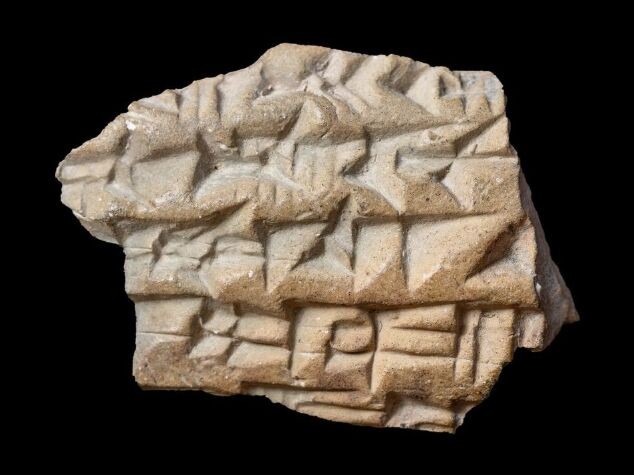
Image: Per the Times of Israel: In 2025, “an Assyrian inscription dating to around 2,700 years ago was unearthed in an archaeological excavation near the Temple Mount in Jerusalem’s Old City — the first time written evidence of the relations between the Assyrian Empire and the Kingdom of Judah was discovered in the city… According to the experts who studied it, the inscription was likely a tax notice from the Assyrian emperor to the Judaean king, echoing the biblical description of how the powerful empire had turned Judah into a vassal kingdom after destroying the bordering Kingdom of Israel.” (Photo by Emil Aladjem/Israel Antiquities Authority)