
Sara Aroeste looks back on her career as a Ladino creator while moving it to the next stage
By Albert Stern / BJV Editor
Those of us living in the Jewish Berkshires for at least the past decade-and-a-half have had front-row seats for the flourishing of singer/songwriter Sarah Aroeste’s career as a champion of Sephardic culture and the Judaeo-Spanish language of Ladino. Her musical range encompasses torchy, romantic interpretations of traditional and original Ladino songs, cheerful and educational children’s music, and what has so far been her most ambitious work, the historical exploration of her family’s Balkan roots in Macedonia, Monastir (2021). Outside the purely musical realm, PJ Library kids have enjoyed her bilingual Ladino/English children’s books and adults may have connected through projects she initiated such as Savor (a collaboration with chef Susan Barocas pairing Sephardic music and cooking that also organizes overseas tours), and her online Livros Lookout book community and Kantikas Countdown spotlight of global Sephardic music.
In light of all that Aroeste’s brand has evolved into, it is interesting to find out that it all began circa 2000 with her first entry level job for the now-defunct National Foundation for Jewish Culture. She was tasked with “putting together a symposium on new Jewish musics,” she says (emphasizing the plural musics), “and, not for lack of trying, I could not find a Sephardic cutting edge musician doing creative contemporary work in the Sephardic music sphere at this incredibly creative time in Jewish music.” This was the heyday of the klezmer revival that saw a huge spike in interest and investment in Jewish culture.
‘I was absolutely bowled over by the creativity coming out of the Jewish music world,” Aroeste remembers. “The flip side was that I was terribly depressed that my culture was not represented in any way. And so – I kid you not – two weeks later, I gave notice to the Foundation. I said, ‘Well, if nobody else is doing this, I'm going to.’”
Aroeste had trained an opera singer and had studied at the Israel Vocal Arts Institute in 1997. “By coincidence,” she says, “my opera coach was the late, great Nico Castel, one of the great vocal coaches at the Metropolitan Opera and the most influential Sephardic musician in America because he had the first commercially published Ladino songbook. Once he realized that we had the same Sephardic background, he began teaching me some of the traditional Ladino repertoire, which I had not grown up with.” Her family, she says, had fled the Balkans in the 1910s and did not emphasize their cultural roots while trying to adapt to America, so she knew virtually no Ladino songs.
Aroeste continued studying with Castel when she returned to New York and began incorporating Ladino music into her classical recitals. She says: “Without fail, audience members would come up to me afterwards and tell me that the Ladino portion was their favorite part. And I really had to stop and think about it. Was it because it was unfamiliar, so their ears perked up and they listened more carefully? Or was it because I was singing it in a different way than perhaps I was singing Mozart, because I connected with the music more? I suspect it's probably a combination of the two, but ultimately I agreed – I much preferred the Ladino music over the opera.
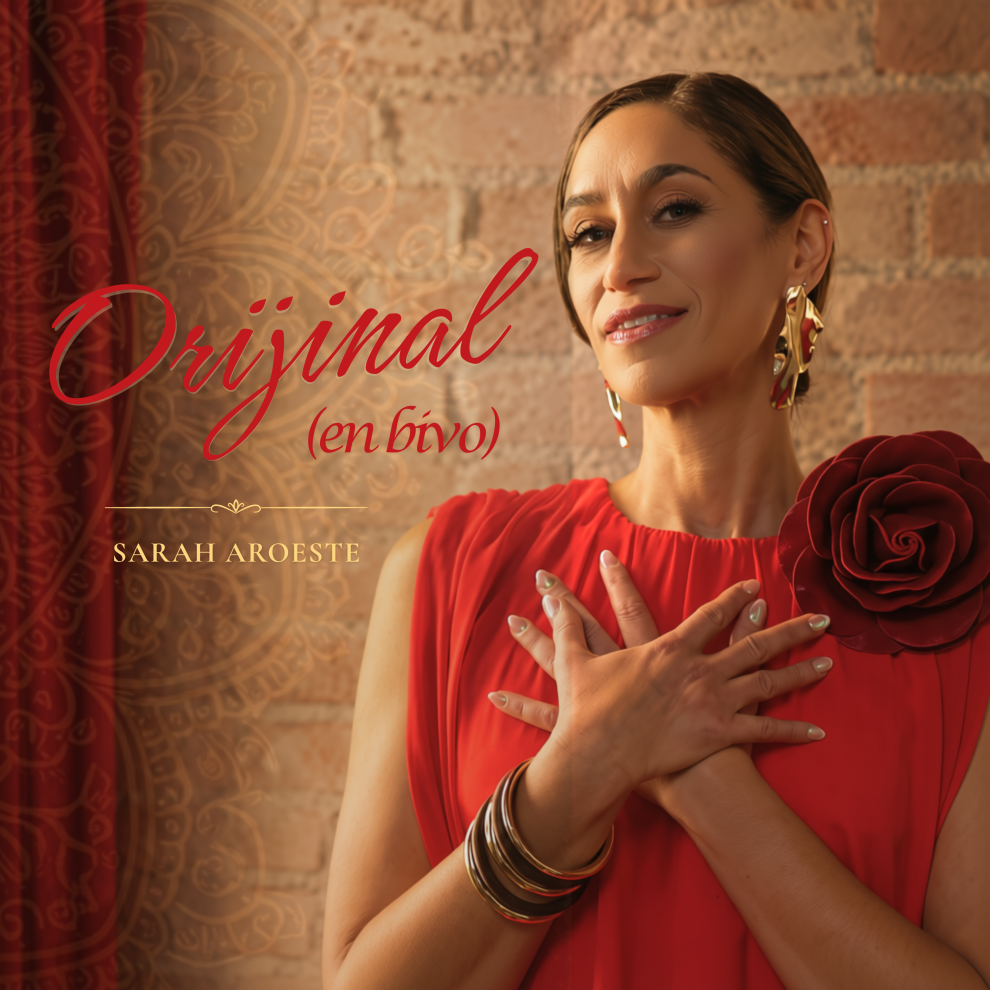
Aroeste’s just-released ninth album, Orijinal (en bivo), is a retrospective of her 25-year journey through Sephardic culture as a creator of new music. The collection features reimagined versions of 11 songs from her catalog but, she asserts, “this is not a greatest hits album, meaning it's not the songs that may have been the most popular. These are the songs that that were so meaningful to me at different stages of my life…from that angsty 20-year-old doing my starving artist New York routine” through motherhood and artistic and personal maturity. Aroeste worked with her longtime producer Shai Bakar to reimagine her songs in a small-band setting of five musicians capable of playing and improvising in different styles.
“I'm all about the hodgepodge, because Ladino music doesn't have one sonic identity,” Aroeste explains, “The Jews who migrated from Spain, especially to the Ottoman Empire, picked up so many influences along the way from their neighbors. You could have some songs that sounded more Western and some songs that sounded more Eastern, and they used instruments from where they ended up. In my own music, I love pairing weird instruments together, whether it's an electric guitar next to an oud, for example. I did a lot of that in my previous work because I could justify it by living in America and using the instruments of American rock and roll. This album, however, is a live concert recording, essentially, and I wanted to keep it intimate, just five instruments and five musicians on all of the songs.”
A perfect example of her process is the song that closes the album, “Espinelo,” which presented Aroeste with a unique and fulfilling opportunity. The lyrics date to 1562, and Aroeste discovered them through the research done by an ethnomusicologist working with the Jewish community in Bitola, as her family’s hometown of Monastir is now known. The community, she says, had preserved these lyrics about a queen pregnant with twins who has to decide which one to keep so as not to be accused of adultery by her superstitious kinsmen – but not the melody. This left Aroeste with creative choices as a composer. The version that first appeared on her Monastir album was conceived for a male singer and performed by Israeli flamenco artist Yehuda Shuky Shveiky, whereas in the version on Orijinal (en bivo), Aroeste herself delivers a propulsive version tinged with a folk-rock sound that is completely different from her original concept.
The musicians came together at a recording studio in Queens, NY, for three days, hashing out ideas together for the first two and then recording the music as a concert on the third. “Shai and I purposely left a lot unplanned because we really wanted the musicians to come to the studio with their own vibe and their own ideas,” Aroeste says. “We did just enough to then let everybody have a chance to breathe. Then on, the last day, we filmed it and recorded it.” The process encouraged spontaneity in the moment, and was also designed to create a format for the music that could be replicated and taken out on a concert tour in the works for 2027 and 2028.
Even looking back, Sarah Aroeste is ever looking ahead to what’s next. The Ladino landscape that has emerged in the 25 years since Aroeste left her entry-level job at the National Foundation for Jewish Culture has, she reports, totally changed. A turning point was the Covid pandemic, which “allowed Ladino speakers and enthusiasts from around the world to find ways to communicate with one another, and many different types of forums cropped up that allowed this beautiful synergy and communication across borders. This awareness of Ladino has only helped the musical aspect.”
She adds, “Now there are entire Sephardic music festivals and many, many more musicians. That's all terrific, still but there are not so many people writing new music in Ladino. And that's really why I wanted to do this album, because I wanted to put my stamp on something and show that we can't only be doing what is considered traditional music. And what is traditional music anyway? We cannot trace most Ladino melodies back beyond 100 years, truly. We need people to preserve that body of music, but I also am so deeply proud of the work that I've done to compose new music in Ladino and to show that it is a living, breathing language.”
For more on Orijinal (en bivo) and to watch in performance videos of her recording of the album, visit saraharoeste.com.