
By Carol Targum / Special to the BJV
Two decades ago, my husband and I moved to Boston to be closer to our family and our second home in the Berkshires. As we learned about the Jewish community, we repeatedly heard about a new, innovative institution called Mayyim Hayyim.
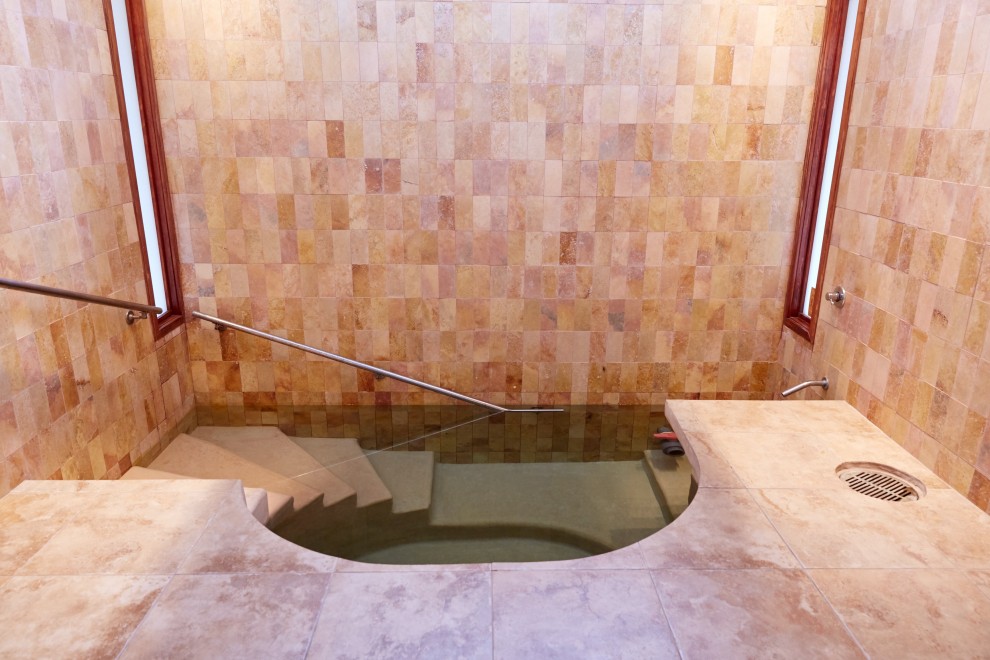
Mayyim Hayyim’s mission is “to reclaim and reinvent one of Judaism’s most ancient rituals – immersion in the mikveh – for contemporary spiritual use; to teach about this resource to all who are interested; and to make the mikveh a sacred space that is open and accessible to all Jews and those who are becoming Jews.” Mayyim Hayyim is a place that is inclusive, pluralistic, creative, accessible and relevant to 21st century life. We were intrigued.
Several months later, my husband was diagnosed with prostate cancer, had surgery, and made a complete recovery. He noted that for the rest of his life, he would have to check the box…”Cancer.” Having recently taken a tour of Mayyim Hayyim, I casually suggested he might want to immerse to mark this moment of being cancer-free. “Yes!” I was shocked by his response. After speaking with our rabbi, he developed a ceremony that met my husband’s desire to capture the spirit of surviving cancer.
Following his immersion, my husband's eyes glowed. The stress had drained from his face. He leaned over to me quietly and whispered, “I’m free.”
The Jewish tradition has many ceremonies and customs, both formal and informal, to mark meaningful moments: a bris or a baby naming, saying kaddish for a loved one, placing a mezuzah on a doorpost, and eating traditional foods on holidays. What about the other moments, transitions, and occasions in our lives that are not prescribed by Jewish law or custom? When can we reflect on major life changes, mark events, or express gratitude with intention (kavanah)?
Since its opening in 2004, Mayyim Hayyim has been a fountain of creativity that has inspired new ceremonies to meet the needs and desires of contemporary life in a Jewish context. Now there are immersion ceremonies surrounding creating a family, B’nai Mitzvah (for both child and parent), blessings for milestone birthdays, for honoring the process of coming out, becoming a grandparent, finalizing a divorce, healing both physically and mentally, completing Sh’loshim (30 days of mourning), and many others.
Before the birth of my first grandchild, I knew I wanted to mark this wonderful transition of a new and long-awaited role for me. I wanted to express my feelings, all the hopes and dreams within me, and somehow proclaim this special and wondrous transition. I knew that the way for me to do this was by immersing in the mikveh.
I asked my daughter-in-law to witness my immersion at Mayyim Hayyim. Six weeks later, she stood on the pool deck with my infant granddaughter in her arms. I immersed to acknowledge the blessing of experiencing l’dor v’dor – generation to generation – the ongoing cycle of life. I prayed to be fully present for this precious child, to give her what was best and pure in me, to teach her Jewish values, and to open my heart so that I could learn from her. Immersing allowed me to express everything that was in my heart, this ancient ritual had become my own very personal prayer.
Jewish Federation of the Berkshires is the glue that binds together this Jewish community. And its mission of sustaining and nurturing Jewish community aligns with the mission of Mayyim Hayyim. Federation partners with local rabbis and synagogues, many of whom choose Mayyim Hayyim as the place to conduct conversions and life cycle events, ritually and spiritually.
Berkshire County has experienced significant antisemitism over the past few years. Incidents include swastika graffiti and antisemitic writing in school bathrooms, bomb threats to synagogues, and harassing emails sent to Jewish leaders. Several years ago, some Jewish middle school students in the southern Berkshires were personally targeted by antisemites. Federation and Hevreh of Southern Berkshire arranged for these students to travel to Boston for a day of healing and education. After a program and an interactive workshop about antisemitism, the students were given a tour of Mayyim Hayyim and offered the opportunity to immerse.
One by one, they emerged from the mikveh looking less stressed. They deemed it a “cool” experience; they felt the soothing waters and spiritual energy that Mayyim Hayyim provides.
Mayyim Hayyim uses the practice and tradition of the mikveh to nurture and sustain Jewish life in a meaningful and relevant ways. Discover the power of Mayyim Hayyim for yourself. Schedule a tour, join an educational program, or come to immerse. Learn more at mayyimhayyim.org.
Carol Targum is a trustee of Mayyim Hayyim Living Waters Community Mikveh in Newton, MA.