
Chabad of Williamstown’s doors are open in the northern Berkshires
By Albert Stern / BJV Editor
The recently-opened Chabad of Williamstown is located in one of the most attractive settings in the Berkshires, surrounded in the distance by some of the prettiest hills we have in the region. But its first home in ‘The City Beautiful’ is a little on the rough side, situated in an apartment building a bit outside the center of town.
But even before the door opened on my first visit, the wafting aroma of chocolate chip cookies baking hit me, activating food-centric memories of the many Chabad outposts I’ve visited over the years. The warm hug from Rabbi Mendel Volovik as I entered the space was also familiar – I’ve known Mendel since he was a serious and devout child at Chabad of the Berkshires, which his parents Sara and Rabbi Levi Volovik opened 21 years ago in Pittsfield and which moved to its new building in Lenox last summer. Full disclosure – I am the gabbai at Chabad of the Berkshires and have been spiritually and emotionally invested in its expansion. If my experience of the Lenox center is of seeing something blossoming upon deep roots, on my visit to the Chabad of Williamstown I felt I was witnessing a newly planted seed just beginning to germinate.
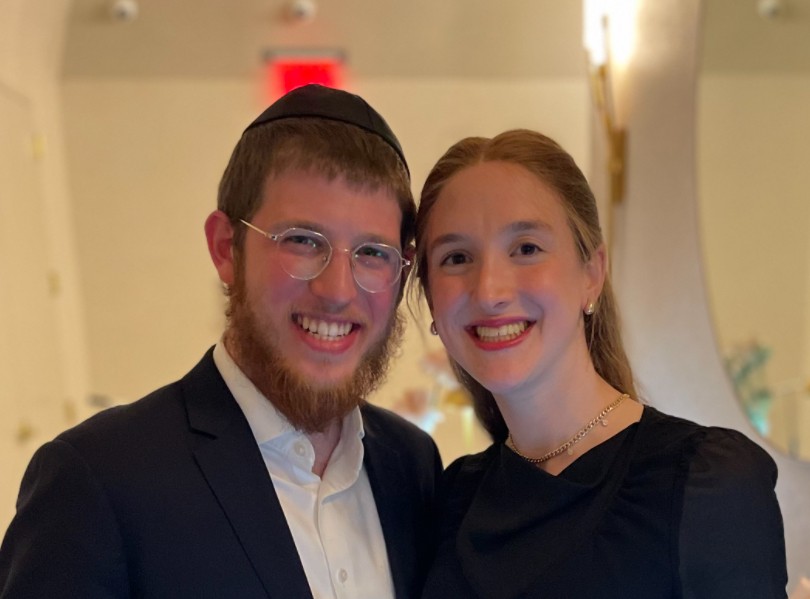
Rabbi Mendel, 25, is now a serious and devout adult, husband to Tzivia, 23-years-old and the co-director of the new Chabad, and father to an infant son, Yosef. The couple is not much older than the students at Williams College with whom they have started to connect – this spring, the Voloviks were regularly hosting Shabbat dinners that attract from twenty to forty people from the college on Friday evenings. These students will mostly use Williams as a springboard to careers in the wider world; in contrast, the Voloviks know that Williamstown is a lifelong commitment, as Chabad shluchim (emissaries), despite the international character of the movement, typically remain in one community for the duration, no matter how Jewishly remote that location might be. And despite all Chabad outposts being connected through the movement, each center is a separate entity operated by its shluchim, who must raise funds and manage all aspects of its day-to-day functions and long-term planning.
Rabbi Mendel says he’d contemplated the possibility of becoming an emissary since his mid-teens, but that “it wasn’t necessarily a given that I wanted to go into a Jewish field. I have family from both sides that are successful in the world of business, and that was definitely something that could have had an appeal. My children might be able to go to a Jewish school five minutes away, where they’d have friends like them. Nevertheless, we decided to come to Williamstown. To be honest, we didn’t really look at it as a way of going back to the Berkshires, because it’s so far from where my parents live.”
Says Tzivia: “When we got married, we both had the same idea that we wanted to go out there and create our own community where we could be there for Jewish people. But it was not just about us, but where can we find the place that actually needs us? Where is there a need we could fill based on our dreams? It was the students at Williams who did call out to us and tell us that there was a need.”
The couple brings different experiences of the Chabad world to this new endeavor. Mendel is the oldest of seven children and grew up in Pittsfield, where his family lived above the living room shtiebel where Chabad of the Berkshires conducted services in all but the height of the summer season, often struggling to make a minyan during the cold winter months. In contrast, Tzivia is the sixth of eight children whose parents are two of four co-directors of the Montreal Torah Center, connected with 1800 families in a metropolitan area with more than 90,000 Jews and at least 14 other Chabad synagogues and more than 40 Chabad-affiliated social, educational, and outreach organizations.
“At the groundbreaking for [the Torah Center], I was in my stroller,” Tzivia says, “so I don’t remember life before my parents had a building. But in general, they're very growth-oriented people. Yes, Montreal is a big town that comes with its own set of challenges and its own set of perks. But at the end of the day, the goal and the mindset are the same – we want to find every Jew and make sure that they know that we're here for them and that they're Jewish, and that they should be proud Jews and know that we're a community. I did definitely grow up in the environment where things were more established, but the mentality was always there that we always need to grow. So, I do understand the drive of building something up.” Tzivia’s parents, Rabbi Itchy and Zeldie Treitel, operate The Family Store, a subsidized grocery warehouse offering affordable food and household essentials to over 500 families in need. She says her own outlook has very much been shaped by her parents’ efforts to nourish members of her community by giving them the opportunity shop for kosher food with dignity.
The Voloviks also embark on their shelichut at a time when campus life can be fraught for Jewish students experiencing antisemitism from their peers and even from their teachers and administration. Mendel says that the Williams community has been very welcoming, and that he has met with key administrators and studies weekly with Rabbi Seth Wax, the College Chaplain and Director of Jewish Life at Williams College. “We’ve never experienced antisemitism,” he says, “but we know that some students have. Our goal is to do what we can to pump up the pro-Semitism and see to it that they feel safe, secure, and comfortable.”
The Voloviks had ongoing conversations with other campus Chabad emissaries to learn how to work within a university setting where the student body changes from year to year and the academic calendar organizes everyone’s schedules. Being a shaliach with a university focus requires engagement not only with undergraduates and graduates, but with professors, administrators, alumni, parents, and faculty families, as well. The Voloviks also intend Chabad of Williamstown to ultimately serve as a Jewish hub for the entire Jewish community of the northern Berkshires, but say that in these early stages most of their time is invested on establishing personal relationships within the college in order to find out what students want from their Chabad. “We’re going to ask them what do they want to see,” says Mendel, “and as long as it works with halacha, we will do the best we can.”
Williams College senior Arielle Levy is one of those students who reached out to the Voloviks and who says she is thrilled with the first steps they have taken to establish another Jewish space for students in Williamstown. “It’s kind of like a startup,” says the Political Science major. Friday night dinners have “extreme young energy in a setting with a treehouse aesthetic. They are extremely motivated.” Levy is a product of a Ramah School in New Jersey and is founder of the Williams chapter of the TAMID Group, which connects future leaders with Israeli-based startups for hands-on business experience. Her previous connection with Chabad was as a traveler and then as a regular when she studied at the London School of Economics. She says that she and other Jewish students felt isolated on campus after October 7; through connections made Chabad of Williamstown, she has found peers who are now part of an online social group, as well as regulars on Friday night. As someone who has, as she describes it, a “traditional background,” she appreciates the “powerful display of Jewish pride” she’s experienced at the new Chabad House. Levy, who will be working in finance after graduation, says she hopes to help create an alumni group in the years ahead.
“We’re very into personal connections,” says Tzivia, “one student at a time. One student will come over for Friday night dinner, and then they want their friend to be involved. And that’s how we’re building our community. We started with knowing one student and now we have a group chat with more that 40 students.” She is also the engineer of “The Chicken Soup Express,” which delivers containers of homemade Jewish penicillin to the dorms and can be ordered by students and their parents via the Chabad of Williamstown website.
“I think a mistake people make is to think Chabad is an Orthodox shul with things on the side,” says Mendel. “On the contrary, we are a home for every Jew. Like the Rebbe said when he assumed leadership in 1951, on the heels of the Holocaust, that Hitler chased down every Jew with hate and that we are going to make an army to chase down every Jew with love. We are not going to wait for a Jew to come to us. We are going to make sure they know we’re here for them and we’re embracing them. And, we’re going to have a shul on the side – but that’s not the main thing.”
For two people who are so young, the Voloviks are uncommonly grounded as they look toward the future. Rabbi Mendel says he looks forward to establishing a career that lives up to an institution of Williams College’s caliber, and with working with the generations of bright individuals who will study and work there. He impressed me when he shared that now he may seem like a peer to the students who come to Chabad of Williamstown, but that as he gets older, he might seem more of a parental and then even a grand-parental figure. For me, hearing the couple talk of their future as young Yosef bounced on Mendel’s knee was especially poignant in light of the ordeal they experienced two days after their son’s bris and just after the conclusion of Rosh Hashanah, which they spent with Tzivia’s family in Montreal.
“On Wednesday night, as I wished my wife a good night, I collapsed due to a cardiac arrest,” writes Mendel. “They didn’t know if I would survive, let alone return to good health. Our entire world turned upside down. I finally woke up two days later. It took about a week before the doctors realized that I would return to full health. But obviously, it took a few months for me to recover, and that’s why were only able to arrive in Williamstown in January 2026, rather than at the start of the school year.”
When asked how their experience affected their outlook, Tzivia answered: “It solidified what our beliefs were before. From the Rebbe, we have this mindset that we have a mission and that we are here for a reason. Time is precious. Every moment matters. And I think we really learned that from experience is that it’s not even moments – it’s more like seconds. Everything takes a second. And every second in our life is a time where we could choose to do something good for the world. It just strengthened our urgency to do what's needed from us and to be active players in the world.”
“We definitely learned the power of time and moments and days,” Mendel adds. “Such darkness can happen in a split second – but light is so much more powerful than darkness, right? Especially the light of Hashem, the light of a Jew, the light of Torah.”