
By Dara Kaufman / Executive Director, Jewish Federation of the Berkshires
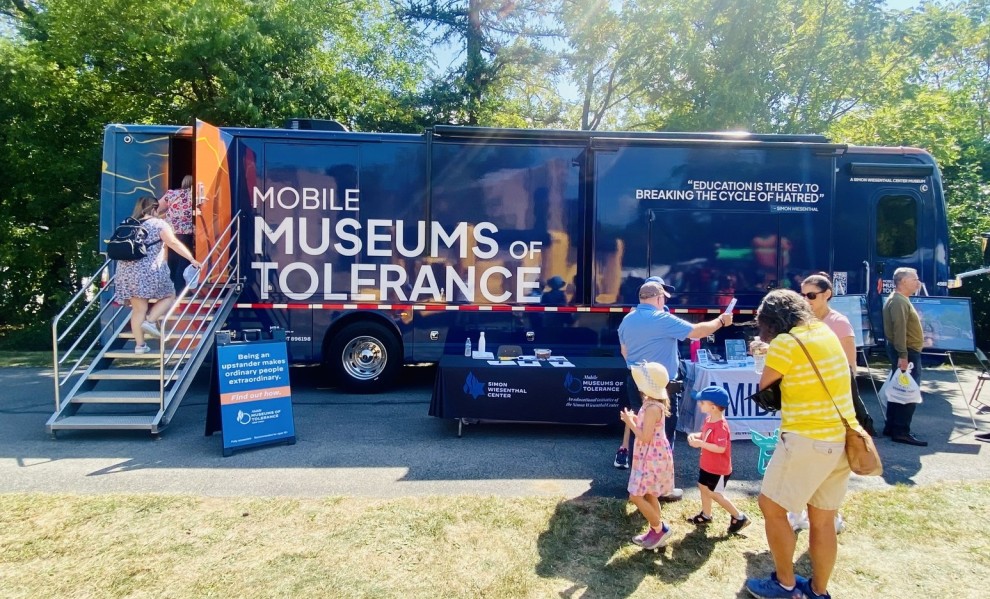
Last November, Jewish Federation of the Berkshires, alongside Berk12, partnered with the Simon Wiesenthal Center to help launch the Massachusetts Mobile Museum of Tolerance (MMOT) and bring this educational resource to Berkshire County schools. Our goal was simple: to give local students the opportunity to explore difficult subjects such as antisemitism, racism, prejudice, discrimination and the Holocaust in ways that are engaging, age-appropriate and meaningful.
Since then, the results have been remarkable.
The Mobile Museum of Tolerance has visited ten Berkshire schools, delivered 89 workshops and reached 1,727 students in grades 5–12. Students at Berkshire Country Day School, BART Charter School, Mount Everett Regional Middle and High School, Morris Elementary School, Miss Hall’s School, Drury High School, Eagle Academy, Williamstown Elementary School, Mount Greylock Regional School and Lenox Memorial Middle High School have participated, with additional schools scheduled to host the museum this fall and winter.
The MMOT is a first-of-its-kind initiative in Massachusetts, created by the Simon Wiesenthal Center and fully funded by the Massachusetts Legislature. Its 30-seat, wheelchair-accessible vehicle serves as a highly interactive classroom on wheels. Led by licensed educators, it uses technology, multimedia and facilitated discussion to help students understand the consequences of hatred and prejudice and consider what they can do to make a difference.
The workshops explore these issues through different lenses. “Anne Frank: A Voice of Hope” introduces students to Anne’s life and legacy while helping them understand the human impact of the Holocaust and antisemitism and the courage of those who stood up to help others. The Power of Ordinary People examines the Holocaust through the choices of everyday people, exploring the dangers of propaganda and prejudice and the importance of becoming an “upstander.”
“The Civil Rights Movement: Learning Empathy Through History” explores discrimination, segregation and the continuing work of building a more equitable society. “Combat Hate: Digital Media Literacy” helps students recognize online hate and misinformation, think critically about what they encounter on social media, and consider how their own choices can either contribute to or challenge a culture of hate.
Together, these workshops give students the opportunity to develop empathy and critical thinking while gaining the knowledge and confidence to recognize and respond to prejudice and hate.
These are not easy topics. But that is precisely why creating thoughtful opportunities for students to learn, ask questions and have honest conversations matters.
We have heard from local educators that these experiences are making a difference. Lindsey Brown, middle school team leader at Mount Everett Regional School, described the Mobile Museum as an “invaluable educational program” that provided students with an immersive and thought-provoking experience while promoting empathy, critical thinking and a deeper understanding of bias, discrimination and intolerance. She also noted that the workshops became catalysts for meaningful dialogue and personal growth for both students and educators.
There is good reason to invest in this kind of education. New research released in August by the Anti-Defamation League’s Center for Antisemitism Research found that a single 45-minute classroom lesson on contemporary antisemitism produced measurable changes in students’ attitudes. In a randomized study involving 372 students in nine public middle and high schools, students who received the lesson were 14.4 percentage points more likely than those in the control group to reject the statement that Jews have too much power in the United States. The lesson also produced a 15.5 percent reduction in agreement with the antisemitic “dual loyalty” trope. Perhaps just as importantly, 79 percent of students who received the lesson correctly identified antisemitism as prejudice against Jewish people, compared with 47 percent of students in the control group.
The Mobile Museum is also reaching beyond school walls. Just a few weeks ago, Federation collaborated with the City of Pittsfield to bring the MMOT to September’s First Fridays at Five, where community members could experience the museum and a special art exhibit.
The Mobile Museum of Tolerance is one part of a much broader commitment by Jewish Federation of the Berkshires to working with our schools. For many years, Federation has worked to ensure that schools and young people have the resources and support they need to understand and confront antisemitism and bias, learn about the Holocaust and Jewish American heritage, and build communities grounded in safety, respect and belonging.
We support this work by investing in educational programs, connecting educators with trusted organizations and subject-matter experts, providing resources and guidance for responding to incidents of antisemitism and bias, and sharing lesson plans and educational resources related to the Holocaust, Jewish history and Jewish American heritage. We also support programs such as Changemakers for Good that empower students to become leaders in creating more inclusive communities.
This work closely aligns with the Massachusetts Special Commission on Combatting Antisemitism’s K-12 recommendations, which call for stronger education about antisemitism, Jewish history and the Holocaust, professional development for educators, and effective resources and protocols for responding to antisemitic incidents. Federation is committed to helping Berkshire schools put these recommendations into practice by connecting them with resources, expertise and trusted partners.
Just as important, we have worked to build relationships with superintendents, principals, and faculty so that we can understand what schools are experiencing and respond quickly and collaboratively when challenges arise. Our goal is to be a consistent resource to our schools, not simply when there is a problem, but as they work proactively to educate students and create communities where every young person can learn and belong.
The Mobile Museum of Tolerance is one visible example of this commitment. But it is just one of the many ways Jewish Federation of the Berkshires works alongside our schools to strengthen education, support students and help build a community where there is no room for antisemitism or hate.